Bank and Financial Institution Cleaning: The Security and Compliance Standards Lancaster Facilities Must Meet
What Lancaster County banks must demand from cleaning vendors: background checks, access controls, service logs, and BSA/AML compliance explained.
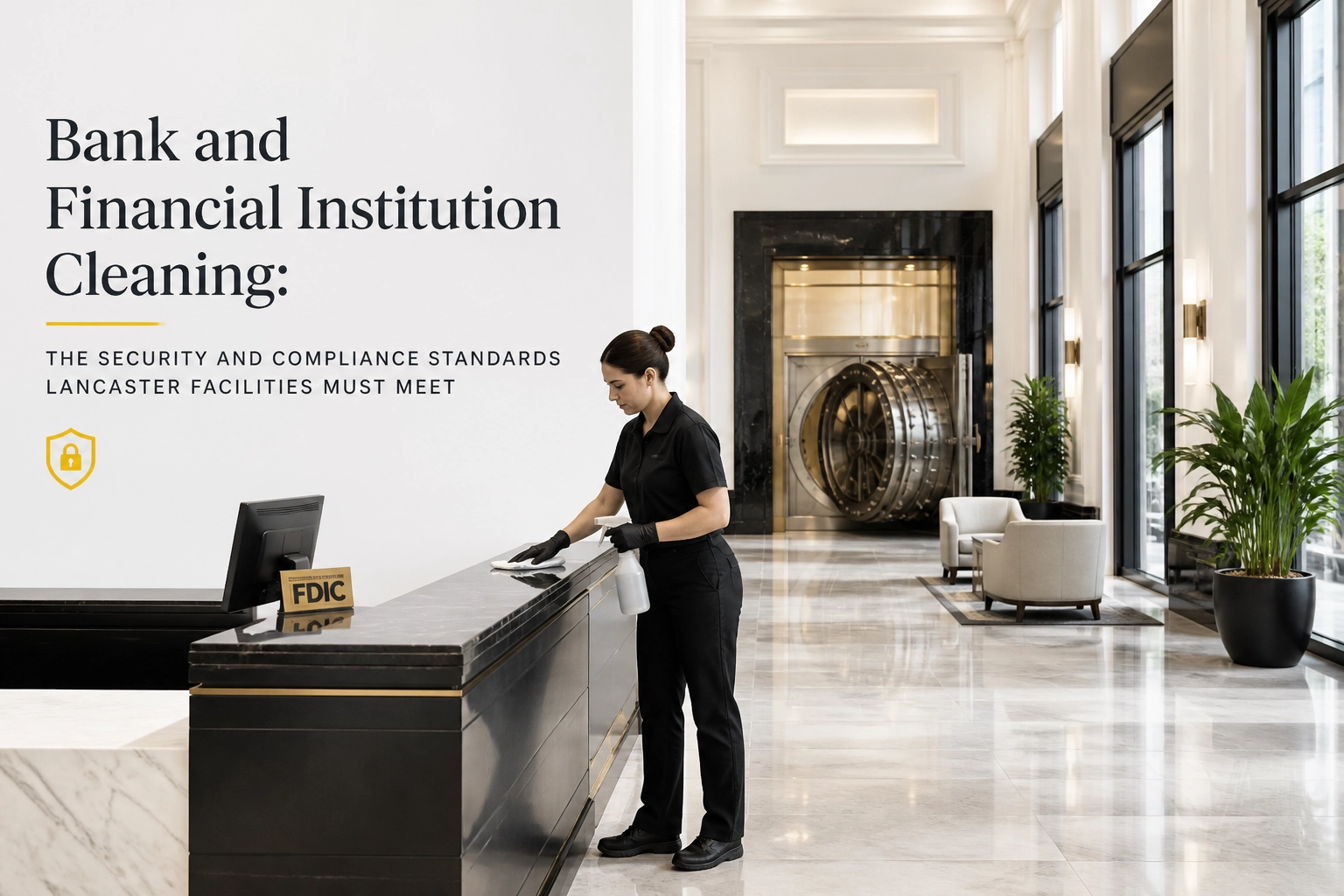
Most banks in Lancaster County look clean. That is not the same as being cleaned compliantly. When a financial institution opens its doors to a third-party cleaning crew, it is not simply hiring a service; it is granting facility access to outside personnel, creating a vendor relationship that federal regulators expect to be documented, monitored, and controlled. For institutions operating under FDIC oversight, that distinction carries real regulatory weight.
The requirements governing commercial cleaning services in banking environments extend well beyond surface appearances. Federal security program obligations, third-party risk management guidance, and broader access-control standards all have something to say about who enters your facility, when, and with what level of documentation behind them. Most cleaning vendors are not built to meet those standards, and most bank operators have not been given a clear picture of what a compliant program actually looks like.
This post breaks down why bank cleaning is a distinct category, what the regulatory framework actually requires from vendors, where gaps typically appear, and what Lancaster County financial institutions should be demanding before signing any service agreement.
Why Bank Cleaning Is a Different Category of Commercial Cleaning
Most commercial cleaning contracts are evaluated on price, scope, and scheduling. At a bank, those factors matter, but they represent only the surface of what a compliant cleaning program actually requires.
Financial institutions operate under federal oversight that extends to every third party with physical access to the building. That includes cleaning crews. Under FDIC third-party risk management guidance, banks bear direct responsibility for vetting, documenting, and monitoring the vendors they allow inside their facilities. A janitorial contractor is not exempt from that obligation simply because their role is operational rather than financial.
The lobby appearance matters, and regulators understand that customer trust begins at the front door. But examiners are equally focused on whether the institution can demonstrate who entered the building, when, and under what controls. A clean branch with no access documentation is still a compliance gap.
The access stakes are higher than most operations managers initially account for. Cleaning staff routinely work after hours in teller lines, vault corridors, server rooms, and back-office areas. Each of those spaces carries specific security obligations under federal oversight. They are not interchangeable with an open-plan office.
Banks that categorize cleaning as a routine facilities expense, rather than a compliance-adjacent vendor relationship, create exposure during FDIC examinations of third-party relationships. Examiners assess whether institutions have evaluated service provider access in the context of safety and soundness, and gaps in vendor vetting or documentation records can produce findings.
The distance between what a standard commercial cleaning vendor delivers and what a financial institution actually requires is wider than it appears on a service proposal.
The Regulatory Framework Behind Vendor Access at Banks
The compliance obligations that shape bank cleaning vendor selection trace directly to federal regulation, not internal policy preference.
Title 12 CFR Part 326 establishes minimum security devices and procedures for FDIC-supervised institutions. Federal security program requirements place responsibility for implementing a written security program squarely on the institution's board of directors. That program must account for every individual who enters the facility, including third-party service personnel. The regulation does not exempt after-hours cleaning crews from its scope.
Federal Bank Secrecy Act obligations require insured institutions to maintain procedures that assure ongoing compliance across all operational controls, including physical access. Cleaning staff who enter teller areas, back-office corridors, or server rooms fall within the population those access controls are designed to address.
FFIEC examination procedures add another layer of exposure. Examiners assess whether institutions have evaluated third-party vendor relationships in the context of safety and soundness. A cleaning vendor with after-hours badge access is a third-party relationship subject to that scrutiny.
Identity verification principles that inform how institutions approach sensitive-environment access apply beyond customer-facing transactions. The underlying expectation is consistent: document who has access to sensitive environments and why.
FDIC guidance establishes that documentation must exist: service logs, access records, and evidence of staff vetting. These records are subject to examination review, which means they must be structured to withstand scrutiny, not simply filed and forgotten.
Regardless of what a cleaning contract states, the bank remains responsible for any gap in vetting or documentation, a point that carries particular weight when examination findings are assessed.
What a Compliant Bank Cleaning Program Actually Requires from a Vendor
Criminal background screening is an operational baseline your institution should require. Every staff member assigned to your facility should be screened before their first shift, with documentation available to the bank on request, not merely held internally by the vendor. A verbal assurance is not a compliance record.
Bonding and liability insurance must be current, institution-specific, and verifiable on demand. A certificate of insurance provided at contract signing and never revisited is not adequate. Coverage should name the bank appropriately, and the vendor should notify you proactively of any lapse rather than waiting for your annual renewal inquiry.
Consistent staff assignment is a common friction point between commercial cleaning programs and financial institution requirements. Rotating interchangeable crews undermines access control. Compliant programs assign named, vetted individuals to each location. Any substitution should trigger a documented approval process, not an automatic swap.
After-hours access protocols require more than handing over a key code. Vendors operating outside banking hours must follow a documented procedure covering badge controls, security system coordination, and defined entry and exit logging. If a vendor cannot describe their access procedure in writing, they are not structured for bank environments.
Service logs must record staff identity, time in, time out, and areas serviced for every visit. These records are not internal vendor housekeeping; they are part of the bank's own compliance documentation and must be formatted to hold up under examination review.
Supervisory oversight closes the loop. Unsupervised, ad hoc cleaning arrangements create accountability gaps that regulators notice. Compliant vendors assign a defined point of contact who manages staff performance, responds to incidents, and maintains direct communication with branch management.
Each of these requirements represents a structural capability, not a policy checkbox. The next question is how many vendors in the specialized cleaning services market are actually built to meet them.
Where Most Commercial Cleaning Vendors Fall Short in Financial Settings
Knowing what compliance requires is one thing. Finding a vendor structured to deliver it is another.
Most commercial cleaning operations are built around efficiency: maximize locations serviced per night, minimize labor hours per square foot, keep crews moving. That model works for office parks and retail strips. It fails in financial settings, where documentation and access control carry legal weight.
Background screening is the most inconsistent variable. Some vendors conduct no criminal checks at all. Others run a one-time check at hiring and never revisit it, with no mechanism for sharing that documentation with a client institution. Neither approach gives a bank the verifiable, on-request records its vendor oversight file requires.
Service logs present a similar gap. When logs exist, they typically serve as internal scheduling records, not compliance-formatted documentation. A log that captures "branch cleaned, Tuesday night" does not tell an FDIC examiner which staff member entered, what time they arrived and departed, or which areas were serviced. That distinction matters when an examination touches third-party access controls.
Staff rotation compounds both problems already noted above, introducing unvetted or unfamiliar personnel without notification to branch management and generating access records that cannot support examination review.
Insurance and bonding documentation is frequently generic. A boilerplate certificate of insurance satisfies a lease requirement; it does not necessarily reflect coverage structured to a financial institution's risk profile or name the institution appropriately.
Finally, vendors without experience in bank environments may not recognize that a teller corridor and a lobby are not equivalent spaces. Inadvertent access to restricted areas during routine cleaning, even without intent, creates the kind of security exposure that surfaces in examinations.
What Lancaster County Banks and Credit Unions Should Demand from Any Cleaning Partner
Knowing where the industry commonly falls short gives your institution a sharper lens for evaluation. When you're vetting a cleaning partner, these are the specific standards worth holding firm on.
Documented background screening, on file before day one. A verbal assurance that staff are screened is not sufficient for your vendor oversight file. Ask for the actual records, confirm they cover every individual assigned to your location, and establish in writing that any new assignee requires the same documentation before their first shift.
Staff consistency with a formal substitution process, ask for named assignments and a written approval requirement for any change.
A service log structured for compliance review, request a sample before signing and confirm it captures the identity, entry and exit times, and areas serviced described in the vendor requirements section above.
Annual insurance and bonding verification, with proactive notification. Don't wait for your renewal cycle to discover a lapse. Require the vendor to notify your branch management immediately if coverage changes, and build annual verification into the service agreement itself.
Demonstrated knowledge of restricted area protocols. A vendor experienced in financial institution work will not need to be told that teller lines, vault corridors, and server rooms carry separate access requirements. If you have to explain the concept, the vendor is not structured for this environment.
A facility-specific written cleaning plan. Generic proposals, listing tasks without mapping them to your actual floor plan, staff assignments, and documentation procedures, signal that the vendor is not built for financial institution work. Insist on a plan that addresses your specific spaces and schedule.
For Lancaster County banks and credit unions specifically, a locally based vendor offers a practical operational advantage: direct communication with branch management, faster response to schedule changes, and the kind of relationship continuity that supports consistent compliance performance over time rather than at contract signing alone.
The Compliance Side Is the Floor -- Presentation Is the Expectation
Meeting the vendor qualification criteria outlined above is necessary groundwork, but it does not complete the picture. Compliance clears a bank to work with a cleaning vendor; it does not guarantee that vendor delivers results worth having.
The lobby, teller counter, ATM vestibule, and waiting area are where customers form their first and most durable impression of the institution. A branch that looks neglected communicates something about its standards, regardless of what the balance sheet says. Consistent, detail-focused cleaning reinforces the trust that financial brands spend considerable resources building.
Specialized cleaning services for financial institutions need to address the specific surfaces that define that impression: hard-floor maintenance that keeps polished tile and stone looking deliberate rather than worn, glass and partition cleaning that eliminates smudges from high-traffic transaction areas, restroom standards that match the professionalism of the public-facing spaces, and high-touch surface protocols for counters, door handles, and transaction stations. All of this must happen without disrupting branch operations or creating security exposure during the process.
A cleaning program that satisfies compliance requirements but executes inconsistently still creates risk. Customer complaints about facility conditions reflect directly on the institution's broader standards, and persistent facility issues can surface as operational concerns during supervisory review under safety and soundness frameworks.
The most effective bank cleaning programs treat compliance documentation and service quality as a single integrated scope, not parallel tracks. Every customer-facing and back-of-house area should be mapped, scheduled around branch hours and staff availability, and executed with the same level of accountability the compliance side already demands.
Choosing a Cleaning Partner Your Compliance Program Can Rely On
Selecting the right cleaning partner for a financial institution is a vendor procurement decision with compliance consequences. The vendor who can document staff vetting, maintain consistent assignments, and format service records for examination review is a fundamentally different category of provider than one who simply cleans well.
Lancaster County banks and credit unions managing third-party vendor risk need a partner who treats documentation and accountability as core service components, not add-ons requested at contract review. Understanding your institution's specific obligations under federal oversight frameworks should drive the conversation from the first call forward.
Haley's Cleaning Service works with financial institutions and commercial facilities throughout Lancaster County and surrounding Central Pennsylvania communities, including Lancaster, East Petersburg, Mountville, and Landisville. We provide vetted staff, documented service programs, and direct communication with the operations and compliance contacts who need it most.
When you reach out, the conversation starts with your compliance requirements: access protocols, documentation standards, scheduling constraints, and restricted-area procedures. Square footage comes later.
If your institution is evaluating cleaning vendors or reassessing a current arrangement, contact Haley's Cleaning Service to request a consultation. Bring your facility's specific requirements to that conversation, and expect a response structured around accountability, not just availability.
Conclusion
Bank cleaning is not a commodity service. It is a compliance-sensitive vendor relationship with real consequences for audit readiness, regulatory standing, and institutional security. The right cleaning partner brings documented staff vetting, consistent personnel assignments, and service records formatted for examination review. These are not premium features; they are baseline expectations for any vendor operating inside a financial institution.
Want it done right?
Residential and commercial cleaning across Lancaster County. Free estimate in 24 hours.
Get a quote