How to Evaluate a Commercial Cleaning Company Before Signing a Contract
Use this office manager checklist to vet a commercial cleaning company on insurance, PA licensing, scheduling, and quality before signing any contract.
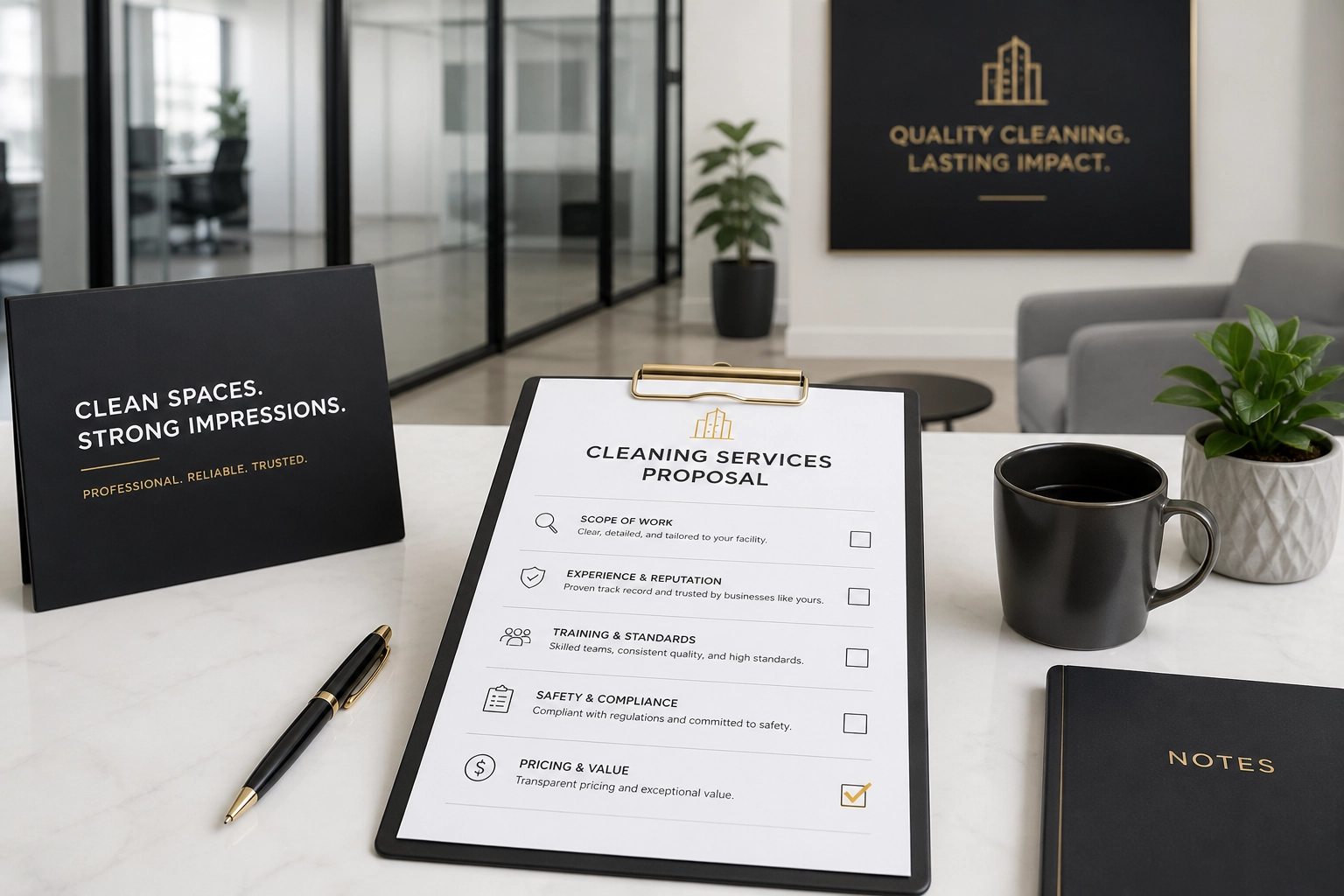
Many office managers sign commercial cleaning contracts based almost entirely on price, and many regret it before the first quarter is over. Service inconsistencies, unexpected charges, and unverified workers on-site are problems that rarely show up in a proposal but surface quickly after the ink dries.
Reviewing a cleaning company proposal carefully before committing is one of the highest-leverage decisions a facility buyer can make. The right vendor protects your workplace, your budget, and your liability exposure. The wrong one creates operational headaches that are difficult and costly to unwind.
This guide gives you a concrete vetting framework built specifically for Pennsylvania office environments. You will learn how to verify insurance coverage in detail, confirm state and local licensing requirements including Pennsylvania Department of Revenue sales tax compliance, assess scheduling accountability, and evaluate quality assurance documentation. You will also find guidance on personnel screening, contract transparency, and reference checks, along with a consolidated checklist you can use before signing anything. Whether you are evaluating your first vendor or replacing a provider who has underdelivered, this process will help you make a confident, well-informed decision.
Why Most Commercial Cleaning Contracts Go Wrong
Commercial cleaning contracts are frequently awarded on price. A vendor submits the lowest number, the office manager gets budget approval, and the agreement is signed before anyone has verified insurance, confirmed licensing, or asked a single operational question. The savings look good on paper until the problems start.
And they do start. Complaints often surface early: cleaning crews that rotate without notice, unanswered calls after a missed visit, invoice line items that don't match the original proposal, and service quality that was clearly better during the trial period than it is now that the contract is locked in. None of these outcomes are surprising when the vendor was selected without a structured evaluation.
The risk goes beyond inconsistent restrooms or a poorly cleaned breakroom. A cleaning company has regular, often unsupervised access to your entire facility, including server rooms, executive offices, file storage areas, and any space where sensitive business information is present. That level of access makes vendor selection a risk management decision, not just a procurement one. Financial exposure from theft or property damage, operational disruption from unreliable scheduling, reputational consequences from a vendor-related incident, and even data security vulnerabilities are all real considerations when an outside team has after-hours access to your building.
A structured evaluation process, completed before any contract is signed, addresses each of these categories directly. The checklist that follows gives Lancaster County office managers and facility buyers a concrete framework for separating dependable vendors from those who simply submitted a competitive number.
What to Prepare Before Evaluating Any Cleaning Company Proposal
Before you request a single proposal, invest time in documenting what you actually need. Vendors can only bid accurately against a clear scope, and you can only compare proposals fairly if every vendor is responding to the same information.
Document your facility specifics first. Record your total square footage, the types of spaces involved (private offices, restrooms, breakrooms, conference rooms, common areas), your preferred cleaning frequency, and any specialized requirements such as post-construction cleanup, gym equipment sanitation, or restricted-access areas. If you manage multiple locations in Lancaster County, document each one separately.
Define your non-negotiables before opening any cleaning company proposal. Minimum insurance requirements, hard scheduling constraints, and communication expectations should be decided internally before a vendor's pitch has any opportunity to reframe them. If consistent crew assignment matters to your operation, that belongs on the non-negotiable list.
Build a standard question set. Use the same questions with every vendor so you are comparing actual answers rather than reacting to each company's presentation style. Sales pitches are designed to control the conversation; your question set is how you redirect it.
Identify your internal stakeholders. Depending on your organization, facilities staff, HR, finance, or building management may all have legitimate input. Know who needs to approve the final decision and what each person cares about most before vendor conversations begin.
Review your current contract if you are switching vendors. Identify the specific gaps and pain points you experienced, and note any contract terms you want to strengthen in the next agreement, whether around scope clarity, cancellation provisions, or quality accountability.
This groundwork takes an hour or two but protects every step that follows.
Step 1: Verify Insurance Coverage in Detail
With your facility profile documented and your non-negotiables defined, insurance verification is the first concrete test any vendor must pass. A verbal assurance or a summary sheet is not sufficient. Request certificates of insurance issued directly by the vendor's carrier, and confirm your organization is listed as an additional insured where applicable.
Here are six key coverage types worth verifying before signing anything:
Commercial General Liability (CGL) is the baseline. It should cover bodily injury, personal injury, and property damage occurring at your facility. Confirm the policy is active, not expired, and that the coverage limits are adequate for your building size and foot traffic.
Workers' Compensation and Employer Liability Insurance is a legal requirement in Pennsylvania for businesses with employees. If a cleaning employee is injured on your premises and the vendor lacks this coverage, your organization can face direct liability. Verify that the policy is current, not just that the vendor carried it at some point.
Crime Insurance (also called employee dishonesty coverage) protects against theft, fraud, or dishonest acts committed by cleaning personnel inside your facility. Cleaning crews often work after hours with minimal oversight; this coverage closes a significant exposure gap.
Inland Marine Insurance covers equipment the cleaning company transports between job sites. If a vendor's uninsured equipment causes damage at your facility, the liability question becomes complicated quickly. Confirm this coverage exists before it becomes relevant.
Bailee's Customers Insurance covers damage to your property while it is under the cleaning company's care, custody, or control. Many vendors omit this entirely. It is one of the most client-relevant coverages on this list and worth asking about directly.
Umbrella Liability Insurance extends coverage beyond the limits of standard policies. A vendor that carries umbrella coverage signals financial stability and a serious commitment to accountability, not just minimum compliance.
When you receive certificates, do not simply confirm the coverage types exist. Check the policy effective and expiration dates, verify the listed limits, and confirm your business name appears where additional insured status applies. A reputable commercial cleaning company serving Lancaster County offices or financial institutions should provide complete documentation promptly, without hesitation.
Step 2: Confirm Licensing and Pennsylvania Regulatory Compliance
Once insurance coverage is confirmed, shift your attention to regulatory compliance. Unlike insurance, licensing requirements for cleaning businesses are set at the state, county, and municipal level. There is no single federal license that qualifies a cleaning company to operate, which means Pennsylvania-specific verification is your responsibility.
Pennsylvania Department of Revenue Sales Tax License
Pennsylvania requires cleaning service providers to hold a valid sales tax license issued by the Department of Revenue. Under Pennsylvania law, both residential and commercial building cleaning services are taxable, and vendors must collect and remit that tax on every invoice. If a vendor you hire does not hold this license, they may not be collecting or remitting sales tax correctly. That creates a compliance exposure for your organization, not just theirs. Ask directly, and ask for documentation.
Workers' Compensation Coverage
Pennsylvania law requires active workers' compensation coverage for all employees, confirm the certificate you reviewed in Step 1 reflects current staff, not a lapsed policy.
Local Business Registrations
Ask whether the company holds any local business registrations relevant to your area. This is a brief but useful signal of whether the vendor has completed their compliance homework at every level.
Industry Certifications
Certifications from organizations such as ISSA or the Building Service Contractors Association International are voluntary, but they indicate that a commercial cleaning company has invested in professional training and industry standards beyond the legal minimum. They are worth noting when comparing proposals.
Get Everything in Writing
A qualified vendor should provide compliance documentation promptly and without friction. Verbal assurances are not sufficient. If a company hesitates or cannot produce documentation quickly, that response itself is useful information.
Step 3: Assess Scheduling Reliability and Accountability Protocols
Once licensing and compliance are confirmed, shift your evaluation to how a vendor actually runs day-to-day operations. Documentation on paper means little if the scheduling falls apart in practice.
Ask directly how the vendor handles missed visits, last-minute substitutions, or schedule changes. A vendor with real operational systems will answer this question with specifics: a notification protocol, a backup staffing process, a documented response window. A vendor who is improvising will give you a vague reassurance. Those are very different companies.
Crew consistency is widely considered a strong indicator of cleaning quality. When the same team services your facility regularly, they learn your layout, your priorities, and your expectations. Frequent rotation resets that familiarity and can be a root cause of quality problems that are hard to trace.
Proactive communication separates professional vendors from reactive ones. Ask whether the vendor notifies you in advance when a schedule change is coming, or whether you typically find out when no one shows up. Consistent, advance notice is a basic operational standard; its absence signals a broader accountability problem.
Ask whether the vendor uses scheduling or job-tracking software that logs arrival times, task completion, and service verification. Digital records create a paper trail you can reference if a dispute arises and confirm that visits happened as contracted.
Understand the escalation path before you need it. If your regular contact is unavailable or a service failure occurs, you should know exactly who to call and how quickly to expect a response. A vendor without a defined escalation structure leaves you without options at the worst possible time.
For Lancaster County offices running early-morning or after-hours cleaning schedules, confirm the vendor has a track record with those timing requirements, not just a willingness to try them. Off-hours reliability requires staffing depth and scheduling discipline that not every vendor has built.
Step 4: Evaluate Quality Assurance and Documentation Standards
Scheduling reliability tells you whether a vendor will show up. Quality assurance tells you whether the work is actually done right when they do.
Start with the written scope of work. Ask every vendor candidate to provide a cleaning specification document that defines exactly which areas are cleaned, which tasks are performed in each, how frequently, and to what measurable standard. Vague agreements like "thorough cleaning of common areas" are a common source of quality disputes because they leave interpretation open to whoever is holding the mop that night.
Next, ask about inspection protocols. A commercial cleaning company with genuine quality standards will have a supervisor or account manager conducting scheduled site inspections, not just responding when you call to complain. Ask how often those inspections occur, what format the results take, and whether those results are shared with you directly. If the answer is unclear or informal, that tells you something important.
Request sample documentation before you sign anything. Ask for a blank inspection report, a task checklist, or a quality assurance form the company actually uses. This immediately reveals whether their process is structured or improvised. A business cleaning company serious about consistency produces documentation that reflects real operational standards.
Ask directly how complaints are handled: what is the resolution process, who owns it, what response time is expected, and what happens if the same issue recurs. A vendor with a defined process will answer this without hesitation. A vendor without one will describe good intentions.
Finally, if you are evaluating a franchise cleaning company, recognize that a national quality framework and local execution are two different things. The brand's standards only matter if the person managing your account has the authority and the operational capacity to enforce them. Ask specifically who handles your account day-to-day, and confirm what decisions that person can make without escalating to a regional office.
Step 5: Ask About Personnel Screening and Background Check Procedures
Documentation standards tell you what gets cleaned. Personnel screening tells you who is doing the cleaning.
Ask every vendor candidate whether background checks are conducted on all employees, at what point in the hiring process, and whether those checks are repeated on a periodic basis. A company that screens applicants once at hire but never again has a gap worth noting, especially for staff with long-term access to your facility.
Direct employees vs. subcontractors is a distinction that matters more than most office managers realize. When a cleaning company staffs your account with subcontractors, its direct control over screening, training, and conduct is limited. Background check standards, insurance obligations, and day-to-day accountability may all be weaker. Ask plainly: are the people cleaning my building on your payroll, or are they independent contractors?
Training standards deserve equal scrutiny. Confirm that new employees are briefed on your facility's specific procedures before their first shift, not coached on the fly after arriving. A vendor with a defined onboarding process is far less likely to send someone unfamiliar with your space into a sensitive area unaccompanied.
If your facility includes server rooms, executive offices, financial records storage, or similar restricted spaces, ask how the vendor controls and documents access during cleaning visits. Verbal assurances are not sufficient; look for a written protocol.
For banks and financial institutions, personnel screening requirements should be rigorous, including criminal history review at a minimum. Apply that same standard to any commercial cleaning company with regular, unsupervised access to confidential business environments. The type of facility may differ, but the access risk does not.
Step 6: Review Contract Terms and Pricing Transparency
Once you've confirmed who is entering your facility and how they're vetted, turn your attention to the document that governs the entire relationship: the contract itself.
Request an itemized proposal that separates base service pricing from periodic or add-on services. Two proposals can look nearly identical in total cost while hiding significant differences in what's actually included. Vague line items like "floor care as needed" create the conditions for invoice disputes; specific line items prevent them.
Understand the commitment structure before signing. Review the contract length, auto-renewal terms, and cancellation provisions carefully. A vendor that stands behind its service quality should not require you to lock in for an unreasonably long term just to secure the account. Review the notice period for cancellation, a reasonable provision should not require months of advance notice just to exit a service relationship.
Get pricing terms in writing. Ask whether rates are fixed for the contract term or subject to adjustment, and if adjustments are allowed, confirm how much advance notice is required and in what form. Verbal assurances on pricing carry no weight once an invoice changes.
Compare the signed scope of work to what was discussed during the sales process. Discrepancies between a salesperson's promises and the contract language are a concrete warning sign. If floor care, restroom cleaning, or breakroom service was discussed but is absent or ambiguous in the final document, resolve that before signing, not after.
Review indemnification and liability clauses with the same care you applied in Step 1. These clauses determine what happens when property is damaged during a cleaning visit, and they interact directly with the insurance coverage types you verified earlier, particularly Bailee's Customers coverage and Commercial General Liability limits.
A well-structured commercial cleaning contract should define service frequencies, task-level specifications, escalation procedures, and dispute resolution steps. If any of those elements are missing, ask why.
Step 7: Check References and Verify Local Reputation
References and reputation checks are the final layer of due diligence, and one of the most revealing.
Request references from current clients with similar facility types. Two or three is the minimum. An office manager reference from a comparable workplace is genuinely more useful than a glowing testimonial from a retail store or residential client. Cleaning a professional office environment involves different access requirements, scheduling constraints, and quality expectations. Relevant references tell you something actionable.
When you speak with those references, ask specific questions:
How long have you worked with this vendor?
Have there been service failures, and how were they handled?
Would you renew the contract without hesitation?
Vague praise is easy to give. Direct answers to those three questions are harder to fake.
Search for the company's local reputation independently. A commercial cleaning company that has genuinely served Lancaster County should have a visible footprint: Google reviews, a stable local address, and some community presence. A thin or inconsistent online history is worth noting, particularly if the company claims years of local experience.
For franchise cleaning companies, separate brand from franchisee. A national brand's reputation does not transfer automatically to the specific local franchisee managing your account. Ask who owns and operates the local franchise, how long they have been in business under that ownership, and who personally oversees client accounts.
Ask the vendor directly how they have resolved a service complaint or scheduling failure. A prepared, specific answer with a concrete example signals operational maturity. Deflection, vague reassurances, or the inability to name a single example signals the opposite. How a vendor responds to that question is often more revealing than the answer itself.
Red Flags to Watch for During the Evaluation Process
Reference and reputation checks reveal a lot, but how a vendor behaves throughout the evaluation process can be just as informative as anything a reference tells you.
Watch for these warning signs before you sign anything.
Documentation delays or reluctance. A qualified commercial cleaning company keeps certificates of insurance, licensing documentation, and references readily available. If a vendor hedges, stalls, or promises to "get those over soon," treat it as a meaningful signal, not a minor inconvenience.
Proposals that are unusually low without explanation. Underbidding is rarely a stroke of efficiency. When a cleaning company proposal comes in significantly below other bids and the vendor cannot explain why, the gap may reflect reduced staffing, compressed training, or cost-cutting on compliance requirements. Price should reflect real costs, not win the contract at the expense of those costs.
Generic scope-of-work language. If the proposal reads like a template that could apply to any facility, it probably does. A vendor who listened during your site visit will reflect your building's specific spaces, priorities, and constraints in writing. Vague deliverables create the disputes you were trying to avoid.
Vague or improvised answers about inspection schedules or performance documentation. That absence will follow you through the entire contract term. Consistent service requires a defined system, not good intentions.
Pressure to sign quickly. Urgency tactics that discourage you from verifying insurance, checking references, or reviewing contract terms are a sign the vendor is more interested in closing than in earning your trust. A confident business cleaning company welcomes thorough review.
Conflicting answers across the team. If the salesperson and the operations contact give you different answers about crew assignments, scheduling coverage, or service protocols, those gaps in communication will show up in your facility. Internal consistency is a basic indicator of operational reliability.
Your Pre-Contract Vetting Checklist at a Glance
Once you have identified the red flags and know what to watch for, put everything into a single reference you can work through before any contract is signed.
☐ Insurance verification Confirm certificates of insurance for all six coverage types: Commercial General Liability, Workers' Compensation, Crime (employee dishonesty), Inland Marine, Bailee's Customers, and Umbrella Liability. Request certificates directly from the carrier, and verify your business is listed as an additional insured where applicable.
☐ Pennsylvania compliance Obtain written confirmation that the vendor holds a valid Pennsylvania Department of Revenue sales tax license and carries PA-mandated Workers' Compensation Insurance for every employee, including part-time and seasonal staff.
☐ Scheduling accountability Document crew consistency expectations, preferred communication channels, and the job-tracking system the vendor uses to verify service completion. Confirm who handles escalations when your regular contact is unavailable.
☐ Quality assurance Require a written scope of work specifying what is cleaned, how often, and to what standard. Confirm that a supervisor conducts regular inspections, that results are documented and shared with you, and that the contract defines a clear complaint resolution timeline.
☐ Personnel standards Verify the vendor's background check policy, confirm that cleaning staff are direct employees rather than subcontractors, and establish documented access controls for sensitive areas such as server rooms, executive offices, or financial workspaces.
☐ Contract terms Review the proposal for itemized pricing, written rate-change notice requirements, and a scope-of-work attachment that matches what was discussed. Confirm indemnification clauses, liability provisions, and a defined dispute resolution process are all present before signing.
☐ References Contact at least two current clients from comparable facility types. Ask specifically how long they have used the vendor, whether service failures occurred and how they were resolved, and whether they would renew.
If a vendor stalls, deflects, or cannot provide documentation promptly, that response is its own answer.
Choosing a Cleaning Vendor You Can Rely On Long Term
The vetting framework in this guide is only as useful as your willingness to apply it consistently.
Haley's Cleaning Service is a locally owned commercial cleaning company built around exactly the standards this checklist describes. We serve offices, banks, gyms, schools, apartment communities, and commercial facilities throughout Lancaster County with verified insurance coverage, documented quality standards, consistent crews, and transparent proposals tailored to each facility's specific needs.
If you are ready to see how Haley's meets every item on this list, we welcome the scrutiny. Request a consultation today and receive a detailed, itemized proposal for your facility. Bring your checklist. We will be prepared.
Conclusion
Signing a commercial cleaning contract without proper vetting is how facilities end up locked into underperforming vendors. The steps in this guide give you a repeatable framework to avoid that outcome. Contact Haley's Cleaning Service today, bring your checklist, and we will show you exactly where we stand.
Want it done right?
Residential and commercial cleaning across Lancaster County. Free quote.
Get a quote