Move-In and Move-Out Cleaning for Lancaster County Property Managers: What a Compliant Turnover Looks Like
Apartment turnover cleaning in Lancaster County: legal compliance, deposit protection & faster re-rental. Learn the documented process property managers
A single missed deadline can cost a Lancaster County property manager the right to withhold a single dollar from a security deposit, regardless of how much damage a departing tenant left behind. That is the reality Pennsylvania law creates, and it is why apartment turnover cleaning is far more than a routine housekeeping task between tenants.
Most property managers understand that units need to be cleaned before a new tenant moves in. Fewer recognize that the cleaning process itself generates the documentation, timestamps, and itemized evidence that either support or undermine a security deposit deduction in court. Without a structured, professionally executed turnover clean, you are not just risking a dirty unit; you are risking your legal standing.
This guide breaks down exactly what a compliant apartment turnover cleaning process looks like for Lancaster County property managers. You will learn how Pennsylvania law distinguishes allowable cleaning deductions from routine turnover costs, what a thorough scope of work covers, what documentation to require from any vendor you hire, and how the right process protects your properties, shortens vacancy time, and keeps disputes out of magistrate court.
Why Turnover Cleaning Is a Compliance Event, Not Routine Housekeeping
Pennsylvania law requires landlords to return security deposits with an itemized accounting of deductions within 30 days of lease termination or surrender. Missing that deadline doesn't just create friction; it can forfeit your right to withhold funds entirely and expose you to financial penalties.
The cleaning work you complete during that window either supports or undermines your ability to make lawful deductions. Each cleaning-related deduction requires photographs, a dated estimate or invoice, and a written explanation of what the condition was and why the work was necessary. Informal cleaning arrangements, a call to a maintenance contact, a favor from a vendor who doesn't issue itemized invoices, produce none of that. The deduction exists in your records as a number with nothing behind it.
The 30-day timeline compounds the risk. A turnover clean that takes longer than it should doesn't just delay occupancy; it delays the documentation you need to finalize deposit accounting. Speed and professional standards aren't separate concerns here. They're the same concern.
Property managers who treat apartment turnover cleaning as a vendor commodity, sourcing whoever is available at the lowest price, are the ones most likely to face deposit disputes. Not because the unit wasn't cleaned, but because nothing in their records can prove what condition it was in, what work was performed, or why any deduction was warranted. That gap is preventable, and the rest of this guide explains exactly how to close it.
The Pennsylvania Legal Distinction That Changes Everything: Routine vs. Targeted Cleaning
Understanding this distinction is what separates defensible deposit accounting from guesswork.
Pennsylvania law recognizes two categories of post-tenancy cleaning. Routine turnover cleaning that would occur even with careful tenant use falls under ordinary wear and tear and is non-deductible. Charging a tenant for it invites a dispute, and in a dispute, the burden is on you to prove the charge was legitimate. Targeted cleaning, applied when a unit is left unreasonably dirty and the lease expressly permits cleaning charges, is an allowable deduction. But allowable is not automatic. It requires documentation that demonstrates the condition exceeded ordinary use.
The practical difference is concrete. Wiping down appliance exteriors after a careful tenant is routine. Scrubbing an oven caked with months of baked-on buildup is targeted. Both involve cleaning the same appliance. What differs is the condition at entry, and that condition must be demonstrable in your records, not just memorable to you.
This is where professional turnover cleaning earns its value beyond the physical work. A cleaning vendor that issues a written scope with condition notes and photographs at the time of service creates a contemporaneous record. That record is what makes a targeted cleaning charge defensible if a tenant challenges it.
Property managers who route turnover work through a maintenance employee or an informal handshake arrangement with a cleaning contact cannot produce dated invoices with itemized deductions that Pennsylvania's deposit accounting requirements demand. A text message confirmation and a Venmo receipt are not documentation. They are liability.
What a Compliant Apartment Turnover Clean Actually Covers
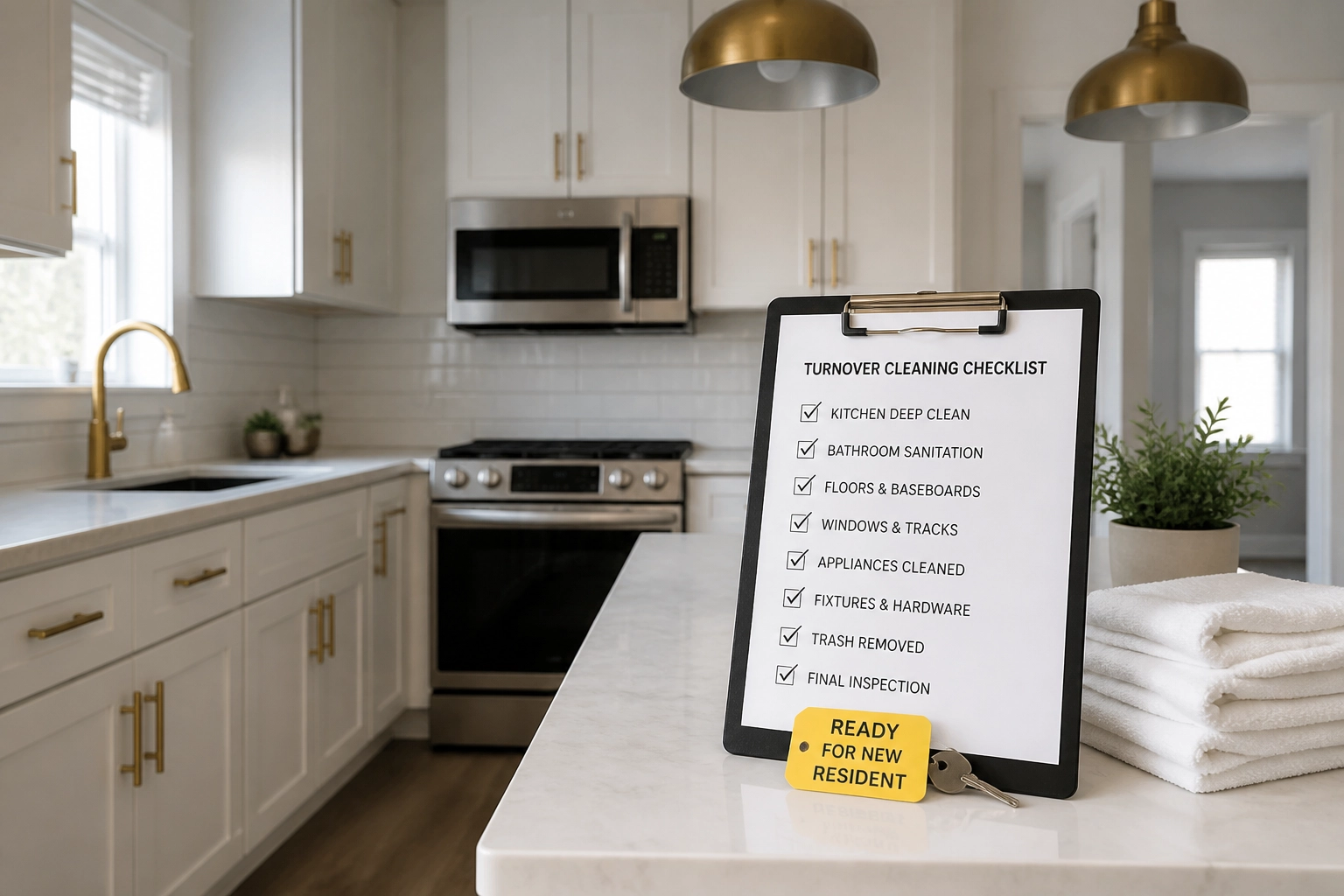
Knowing the legal distinction between routine and targeted cleaning is useful only if you understand exactly what a compliant turnover clean encompasses. Here is what a professionally scoped turnover covers across a typical Lancaster County rental unit.
Kitchen Appliance interiors and exteriors: oven cavity, broiler drawer, refrigerator shelves and door gaskets, microwave interior, and dishwasher interior including the filter. Cabinet interiors, drawer tracks, and hardware. Sink basin, faucet fixtures, and the area around the base of the faucet. Countertop edges and backsplash grout lines.
Bathroom Toilet bowl, tank exterior, and base perimeter. Tub and shower surround with attention to grout lines and caulk edges, where buildup concentrates and photographs clearly. Vanity interior, mirror, and any medicine cabinet shelving. Exhaust fan cover and the floor perimeter at the base of all fixtures.
Living and Bedroom Areas Baseboards, window sills, and ledges. Interior window glass. Closet interiors including shelving surfaces, rods, and floor corners. Ceiling fans and light fixtures. Outlet covers and switch plates, which are frequently missed in routine cleaning but visibly dirty in move-in photography.
Floors Hard surface floors cleaned to a bare-floor standard, including corners and transition thresholds. Carpeted areas require a separate condition assessment; the appropriate cleaning level depends on the unit's condition, and that determination should be documented independently from standard vacuuming.
Entry Points and Transitions Door frames and door tracks. Sliding glass door channels, where debris accumulates. Laundry connections if applicable. Any unit-specific features identified during the pre-clean walkthrough.
A generic checklist applied uniformly across every unit is not a compliant scope. Unit size, condition at entry, and lease terms all shape what the work actually requires, and the written scope should reflect that before cleaning begins.
How Turnover Cleaning Differs from a Standard Apartment Clean
Beyond scope, the nature of turnover cleaning is fundamentally different from recurring maintenance service. Understanding why it's a fundamentally different service than recurring apartment maintenance is what shapes how you scope, schedule, and document it.
A standard recurring clean for an occupied unit assumes surfaces have been maintained between visits. The goal is upkeep: reset the kitchen, clean the bathrooms, address what's accumulated since the last service. A turnover clean starts with no such assumption. The unit is vacated, condition is unknown, and the work must bring every surface to a documented, rent-ready standard suitable for a new tenant and defensible in a deposit accounting.
That distinction changes the cleaner's role. In a recurring clean, the focus is execution. In a turnover clean, condition assessment is built into the work itself. The cleaner notes what required targeted effort versus what was left in acceptable condition, because that record is what separates a deductible charge from a non-deductible routine one under Pennsylvania law.
The scope also operates differently. Recurring service is often adjusted to occupant preference or what's most needed that visit. Turnover cleaning scope is fixed and written in advance, covering every surface category in the unit without exception, because gaps in coverage create gaps in documentation.
Finally, expect more labor hours per unit. Appliances, grout lines, and fixtures accumulate deferred buildup during a tenancy that routine maintenance never fully addresses. That additional labor should appear as a line item on your invoice, not a rounded total, because a cost-specific invoice is what makes a targeted cleaning deduction defensible.
The Documentation Every Property Manager Should Require from a Turnover Cleaning Vendor
The written record your vendor produces is as important as the physical work itself. Here is what to require, without exception.
Written scope of work, unit-specific and dated. Each turnover should begin with a written scope referencing the exact property address and service date. Pennsylvania's Landlord and Tenant Act requires itemized, cost-specific accounting for every deduction. A generic receipt or verbal confirmation produces nothing defensible.
Before-and-after photographs, taken by the cleaning team. Photos should be organized by room and surface category and captured during the service itself. A walkthrough you conduct after the fact does not establish the unit's condition at the time cleaning occurred. Vendor-generated photos taken contemporaneously are what create a usable evidentiary record.
A dated, itemized invoice. Labor and materials should appear separately. More importantly, the invoice must distinguish targeted cleaning work from standard turnover preparation. An invoice that reads only "apartment cleaning" does not satisfy Pennsylvania's requirement that each deduction include an explanation of what happened and why the work was necessary.
Condition notes explaining the work. Targeted cleaning charges require narrative support. Notes should identify which areas required extra effort and describe the specific condition found, not just the task performed. This is what separates a defensible deduction from a disputed one.
Consistent format across every unit. When documentation looks different for each turnover, it signals an informal process. A tenant's attorney will notice. Uniform vendor documentation, same structure, same detail level, every time, strengthens your position across the entire portfolio.
Haley's Cleaning Service provides written scope, photo documentation, and dated invoices as standard components of apartment turnover cleaning services in Lancaster County. The documentation format is built to support property manager compliance, not simply confirm that cleaning occurred.
How a Documented Turnover Clean Accelerates Unit Readiness and Reduces Vacancy Time
Once your documentation is in order, the operational benefit becomes immediate and measurable.
A professionally completed turnover clean delivers a photographed, rent-ready unit the moment the crew wraps. You are not waiting on a separate walkthrough to confirm condition or scrambling to pull together photos before you can list the unit. Marketing readiness and cleaning completion happen at the same time.
That parallel workflow extends to your deposit accounting. When condition notes and dated photographs are produced during the clean, you can finalize your itemized deduction statement and begin re-rental marketing simultaneously. Working sequentially, where documentation follows the clean as a separate step, costs you days inside a window where Pennsylvania law gives you only 30 to work with.
Predictability compounds those gains. Property managers who work with a consistent apartment turnover cleaning vendor can schedule cleaning windows in advance and build realistic unit-ready timelines across their portfolio. Informal arrangements, whether a rotating list of contacts or a maintenance employee handling turnover cleans between other work, make that kind of forecasting unreliable.
Documentation also shortens disputes. When a tenant challenges a deduction, a dated invoice, written condition notes, and before-and-after photographs answer the question definitively. That evidence replaces what would otherwise be a prolonged back-and-forth based on recall.
Pennsylvania law exposes landlords to liability for double the deposit amount when deductions cannot be defended, a financial risk that dwarfs the cost of a professionally documented clean.
What to Look for When Evaluating Apartment Turnover Cleaning Services
Once you've confirmed that your documentation process is working, the next step is making sure the vendor behind it actually meets the standard. Not all apartment cleaning services are structured for property management compliance. Here's what to ask before you commit.
Written scope of work, unit-specific and dated, as covered above, a generic checklist cannot support deposit deductions.
Invoices that separate targeted cleaning from routine turnover, with condition notes, a bare "apartment cleaning" total is not defensible.
Property management experience, not just residential. A vendor experienced with general residential clients may clean well but not understand scheduling around unit access, coordination with leasing staff, or the documentation expectations that come with property management compliance. Ask specifically whether they work with property managers regularly.
Scheduling commitments relative to your 30-day window. A vendor who cannot give you a reliable turnaround timeline creates the same problem as one who doesn't document: your deposit accounting stalls. Get a clear answer on scheduling lead time before you sign anything.
An ongoing relationship, not a transactional one. Vendors who know your portfolio, your standards, and your preferred documentation format deliver more consistent compliance support than rotating providers. Look for apartment turnover cleaning services structured around long-term vendor relationships.
Local knowledge specific to Central Pennsylvania. For Lancaster County property managers, a vendor familiar with the regional rental market understands local property types, tenant patterns, and seasonal turnover volume in ways that out-of-area services simply don't.
Build a Turnover Process That Protects Your Properties and Your Time
Once you've identified the right vendor, the next step is putting a repeatable process in place.
A compliant turnover clean is defined by written scope, dated invoices, and condition photographs that distinguish targeted cleaning from routine preparation. How clean the unit looks on walkthrough matters far less than whether your documentation can withstand a tenant challenge or a deposit dispute.
Pennsylvania's 30-day accounting deadline means your vendor's documentation quality is a direct compliance input, a point established earlier but worth anchoring here as the process rationale.
For property managers across Lancaster County, working with a consistent apartment turnover cleaning services provider builds something more valuable than a clean unit: it builds a defensible record across your entire portfolio. Consistent documentation format, reliable scheduling, and a vendor who understands your properties reduce disputes and accelerate re-rental without adding administrative load.
Haley's Cleaning Service works with property managers throughout Lancaster County and surrounding Central Pennsylvania communities, including Lancaster, Landisville, East Petersburg, Mountville, and nearby areas. If you're ready to put a turnover cleaning program in place with written scope, photo documentation, and dependable scheduling, reach out to request a consultation and we'll build an approach that fits your portfolio.
Conclusion
Turnover cleaning in Lancaster County is a legal event with real financial consequences, not a simple housekeeping task. The property managers who protect their deposit claims and reduce vacancy time are the ones who treat every unit turnover as a documentation exercise first and a cleaning job second.
A clean unit that lacks proper documentation leaves you exposed. A documented turnover clean protects your time, your revenue, and your reputation with tenants.
If you manage rental properties in Lancaster County and want a turnover process that holds up under scrutiny, contact Haley's Cleaning Service today. Build the process once, and let it work for every unit that follows.
Want it done right?
Residential and commercial cleaning across Lancaster County. Free estimate in 24 hours.
Get a quote