School and Church Cleaning in Lancaster County: Scheduling Around People, Not Against Them
Learn how Lancaster County schools and churches can build cleaning programs around busy calendars, vulnerable populations, and multi-use spaces.
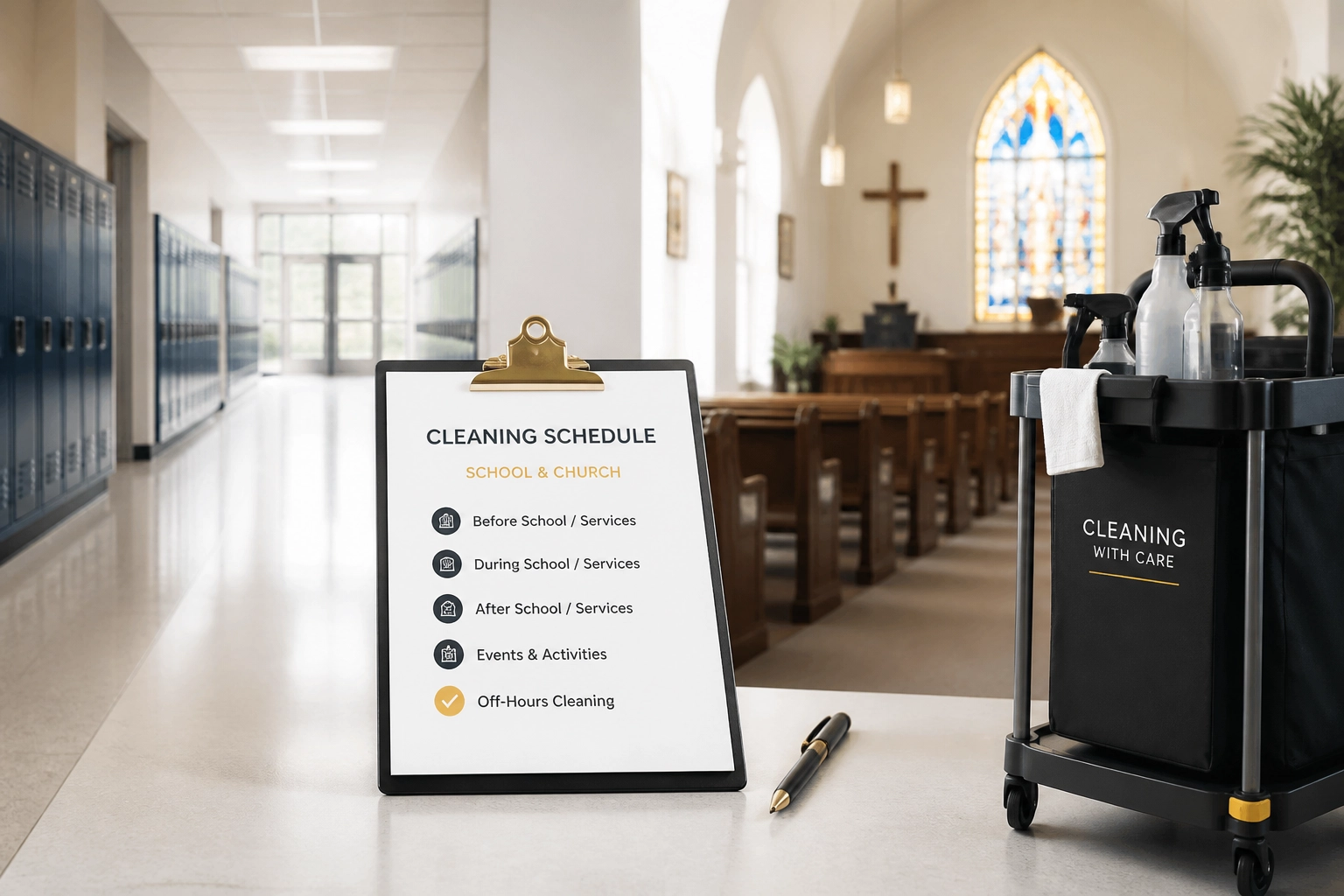
A school gymnasium does not stop being a school gymnasium when the last class ends. A church fellowship hall does not sit idle between Sunday services. These buildings serve rotating populations, absorb back-to-back events, and never fully clear out long enough for a standard cleaning window. That reality is exactly where most commercial cleaning services fall short when they approach schools and churches the same way they approach a corporate office building.
Facilities serving children and elderly congregants in Lancaster County face a particular challenge: the hygiene standards are higher, the schedules are less predictable, and the cost of getting it wrong is measured in sick students and vulnerable adults. A cleaning program that works for a nine-to-five office simply does not translate to a building that hosts a choir rehearsal on Tuesday night, a food pantry on Wednesday morning, and a full student body six days a week.
This post walks facility administrators through the operational differences that define school and church cleaning, how to build a calendar-driven program, and exactly what to specify before signing a contract with a vendor.
Why Standard Commercial Cleaning Schedules Break Down in Schools and Churches
Office cleaning works because the building empties on a predictable schedule. Staff leaves at six, the cleaning crew arrives at seven, and nothing conflicts. Schools and churches in Lancaster County don't operate that way, and any cleaning vendor who assumes they do will create more problems than they solve.
A church facility might host a morning worship service, a grief support group in the fellowship hall by early afternoon, a youth choir rehearsal by evening, and a community dinner that same night, sometimes rotating through the same physical space. There is no clean vacancy window. There is only a series of handoffs between programming events, each one leaving a different soil load and a different setup requirement than the last.
Schools introduce a different layer of complexity. Cleaning frequency must adapt to how heavily a space is used, but the access windows themselves shift constantly. Summer breaks, holiday closures, in-service days, and standardized testing periods all change when and how cleaning crews can enter the building. A schedule built in September may be functionally obsolete by November.
Standard commercial cleaning services are designed around predictable occupancy, consistent room functions, and stable weekly routines. They rarely account for the kind of room-use rotation common in a church or school, where a cafeteria becomes an exam room, a sanctuary doubles as a concert hall, and a classroom hosts three different age groups across a single day.
Forcing a fixed schedule onto that reality produces predictable failures: cleaning crews arriving during active programming, critical spaces missed because an event ran long, and facility staff left managing the fallout. The schedule doesn't fail because the vendor is careless. It fails because it was built for a different kind of building entirely.
Building a Cleaning Calendar Around Your Facility, Not Your Vendor's Convenience
The fix starts before your vendor writes a single line item. Here is how to build a schedule that holds up in the real world.
Step 1: Build a 12-month programming map first. Pull your academic calendar, worship schedule, religious observances, and recurring community programming into one document before any cleaning schedule is drafted. A vendor who sees your full year can spot conflicts before they happen. One who doesn't will hand you a generic template that falls apart by October.
Step 2: Identify access windows by space type. A sanctuary, a classroom, a fellowship hall, and a gymnasium each have different peak-use patterns and different soil loads. A sanctuary may be accessible Monday through Saturday mornings; a fellowship hall may have a two-hour window on Tuesday afternoons. Map each space separately rather than treating the building as a single unit.
Step 3: Schedule project work during genuine low-occupancy windows. Deep-cleaning and annual projects belong in real downtime: summer break for schools, the week between Christmas and New Year for churches, or the stretch immediately after a major programming season closes. These windows should be blocked on the cleaning calendar months in advance, not scrambled for when they arrive.
Step 4: Build buffer time into every week. Last-minute receptions, mid-week funerals, and rescheduled rehearsals are not exceptions in these facilities; they are the norm. Weekly scheduling should carry enough flexibility to absorb one unplanned event without collapsing coverage for everything else.
Step 5: Treat seasonal spikes as named events. Back-to-school disinfection runs and pre-Easter deep cleans should appear on the calendar by name, with defined scope and confirmed dates, well before the season arrives. Reactive scheduling turns predictable surges into emergencies.
A professional cleaning services vendor should ask for your programming calendar before proposing a schedule. That request is a straightforward indicator of operational experience; its absence is worth noting before you sign anything.
Higher Hygiene Standards for Children and Elderly Congregants
Getting the schedule right is only half the work. The other half is understanding who is inside the building and what those populations require.
Children and elderly adults face significantly higher risk from infectious disease than healthy working-age adults, and both groups are regularly present in Lancaster County schools and churches, sometimes in the same facility on consecutive days. A classroom that holds second-graders Monday through Friday may host a senior fellowship group on Saturday morning. That rotation demands consistent hygiene protocols, not just consistent scheduling.
Cleaning and disinfecting are two separate steps, and both are required. Cleaning removes visible soil; disinfecting kills the pathogens that remain on the surface afterward. Applied in the wrong order, or with only one step performed, neither achieves what facilities serving vulnerable populations actually need. A vendor who conflates the two terms in conversation is telling you something important about their protocols.
High-touch surfaces carry the highest transmission risk and require the most frequent attention: door handles, light switches, computer lab keyboards, cafeteria tables, shared instruments, nursery toys, and pew hymnals. These surfaces accumulate pathogen load between uses and cannot wait for the next scheduled deep clean.
In school environments, product selection matters beyond efficacy. Cleaning products used in classrooms and cafeterias should be evaluated for fragrance content, chemical sensitivity, and compatibility with food-contact surfaces. Children and older adults are also among those at increased risk for severe foodborne illness, which makes cafeteria surface treatment a hygiene priority, not a routine wipe-down.
Churches introduce an additional layer of responsibility. Prayer rooms, memorial spaces, and liturgical areas require handling protocols that reflect their significance. A vendor without experience in religious facilities may not recognize the difference between a storage room and a sacristy; that distinction matters to the congregation even when it isn't visible in a cleaning checklist.
At minimum, daily cleaning services in these environments should cover restroom disinfection, high-touch surface wipe-downs, and waste removal. These are not optional tasks between events; they are the baseline that protects the people using the building.
Event-Day Turnarounds: The Hardest Scheduling Challenge in Facility Cleaning
High hygiene standards matter throughout the week, but the single hardest test of any cleaning program happens when two events share the same space on the same day.
Picture a Saturday in a Lancaster County church: the worship service ends at noon, a community dinner begins at five, and the sanctuary is the dining room. That five-hour window has to absorb chair resets, surface sanitizing, restroom restocking, food waste removal, and entry spot-cleaning. General instructions don't survive that window. Discrete, confirmable tasks do.
Build turnarounds into the scope of work explicitly. Name the spaces that require same-day resets, define the acceptable completion window for each, and specify who on the facility side initiates contact when event timing shifts. "Clean between services" is not a scope of work. It is a gap waiting to cause a problem.
Replace general instructions with task lists. Each of the following is a separate, confirmable action:
Reset chairs and tables to the next event's layout
Sanitize shared surfaces, including podiums, serving tables, and door handles
Restock and disinfect restrooms
Clear all food waste and reset trash liners
Spot-clean entry areas and high-traffic floors
A technician can initial each item. A facility manager can verify it. That accountability matters.
Calendar visibility is not optional. A cleaning vendor without access to your programming schedule cannot plan staffing or timing for a same-day turnaround. Share the event calendar in real time, not the morning of.
Designate one contact on each side. One person at the facility communicates schedule changes; one account manager at the cleaning company receives them and acts. Changes that travel through multiple people arrive late or incomplete.
Distinguish large-event cleanup from routine turnarounds in the service agreement. A funeral reception or graduation party generates a different soil load and requires more time and resources than a between-service tidy. That distinction, and how it is priced, should be written into the contract before the first event, not negotiated after.
Documentation: What a Well-Specified Cleaning Program Actually Looks Like
Clear communication protocols and defined task lists solve the event-day problem. What locks those solutions in place is documentation.
A written scope of work is the non-negotiable foundation of any accountable cleaning program. It should name every space in the facility, list the specific tasks assigned to each, set the cleaning frequency, and flag any special handling requirements. Not "clean classrooms", clean Room 104 through Room 112, wipe all desks and chair arms with disinfectant, sanitize door handles and light switches, empty waste bins, sweep and mop floors, three times per week.
Room-by-room breakdowns protect everyone involved. When a service question comes up, both the facility and the vendor have the same reference document. There is no "I thought you meant" and no disputed service history. That written baseline also becomes the standard against which routine performance reviews are measured.
Technician sign-off fields add individual accountability. When a technician initials a completed room log with the date and time, there is a record of who did the work and when. In schools and churches, where community trust and regulatory compliance both carry weight, that paper trail matters more than it does in a standard office environment.
Documentation also provides continuity when staff turns over or vendor relationships change. Facilities operating across multiple spaces, multiple vendors, or shared-use agreements have no reliable institutional memory to fall back on when a key person leaves. A well-maintained cleaning log and scope of work survive personnel changes.
Before signing any agreement, ask prospective professional cleaning services vendors for a sample scope of work document. A vendor who cannot produce one is not operating at the standard a school or church facility requires.
Finally, a documented program supports budget planning. Written service frequencies allow administrators to forecast annual cleaning costs, time seasonal deep-clean investments, and identify tasks where volunteer labor can responsibly fill gaps without compromising professional standards.
What to Specify Before You Hire a Cleaning Vendor for Your School or Church
Once documentation is in place, the next step is knowing exactly what to put in front of a vendor before you commit to a contract. Bring these seven specifications into every conversation.
Hand over your full programming calendar first. Share your academic schedule, worship calendar, recurring weekly events, and any large seasonal gatherings before the vendor proposes anything. Ask them to build their schedule around those windows, not alongside them.
Require a room-by-room scope of work before signing. This document should exist as a contract deliverable, not something the vendor promises to develop after work begins. If they cannot produce it upfront, the program is not yet ready.
Ask directly about same-day turnarounds and short-notice changes. Find out which staff member contacts your cleaning team when a Wednesday night event shifts by two hours, and what the expected response time is. Vague answers here create real problems during busy programming weeks.
Get specifics on hygiene protocols for vulnerable populations. Ask which disinfecting products are used in classrooms, nurseries, and senior programming spaces, at what dilution, and whether those products are approved for the surface types in your facility. "We use commercial-grade disinfectant" is not a sufficient answer.
Clarify how deep-cleaning and project work are priced. Ask whether annual deep cleans are included in the recurring agreement, billed as add-ons, or quoted separately each season. Knowing this before signing prevents budget surprises when summer arrives.
Ask for references from comparable facilities in Lancaster County or Central Pennsylvania. Cleaning a church fellowship hall, a school cafeteria, or a sanctuary requires different judgment than cleaning a corporate break room. Experience with similar facilities in this region matters.
Confirm insurance, technician consistency, and a named account contact. A vendor should carry appropriate commercial liability coverage, assign consistent technicians to your facility where scheduling allows, and give you one accountable person for all scheduling and service communication.
Cleaning Programs That Serve the Community Behind the Building
Once you've asked the right questions and specified the right standards, one reality remains: the facilities that sustain clean, safe environments over time are the ones that treat cleaning as a structured program, not a recurring chore. A calendar, a written scope, a clear communication protocol, and a vendor who genuinely understands the populations being served, those four elements separate a cleaning program that holds up from one that quietly falls apart between events.
Lancaster County schools and churches carry real community trust. The children in those classrooms and the congregants in those pews deserve more than a generic commercial template applied and hoped for the best. They deserve a vendor who has thought through the operational complexity before setting foot on-site.
Haley's Cleaning Service works with schools, churches, and community facilities throughout Lancaster County to build customized cleaning programs around real calendars, real spaces, and real people. Every program begins with your facility's schedule, not ours.
If you're ready to move from reactive spot-cleaning to a documented, consistently executed program, we'd welcome the conversation. Contact Haley's Cleaning Service to request a consultation and a written quote built specifically for your facility. Bring your programming calendar. We'll build the rest around it.
Conclusion
Cleaning a school or church in Lancaster County is not simply a maintenance task. It is a commitment to the people who depend on those spaces every week. The facilities that get it right share four things: a cleaning program built around their actual calendar, written standards that reflect the populations they serve, clear communication protocols, and a vendor who understands the difference between a classroom and a conference room.
Generic schedules fail these buildings. Documented, customized programs protect them.
If your school or church is ready to move from inconsistent spot-cleaning to a structured program that holds up through busy seasons, event turnarounds, and daily use, Haley's Cleaning Service is ready to help. Bring your calendar. We will build a cleaning program around it, one that serves your community as reliably as you do.
Want it done right?
Residential and commercial cleaning across Lancaster County. Free estimate in 24 hours.
Get a quote