Why Lancaster County Offices Need Recurring Commercial Cleaning — Not One-Time Visits
Learn why Lancaster County offices need recurring commercial cleaning, not one-time visits, and how to find a vendor structured to deliver it.
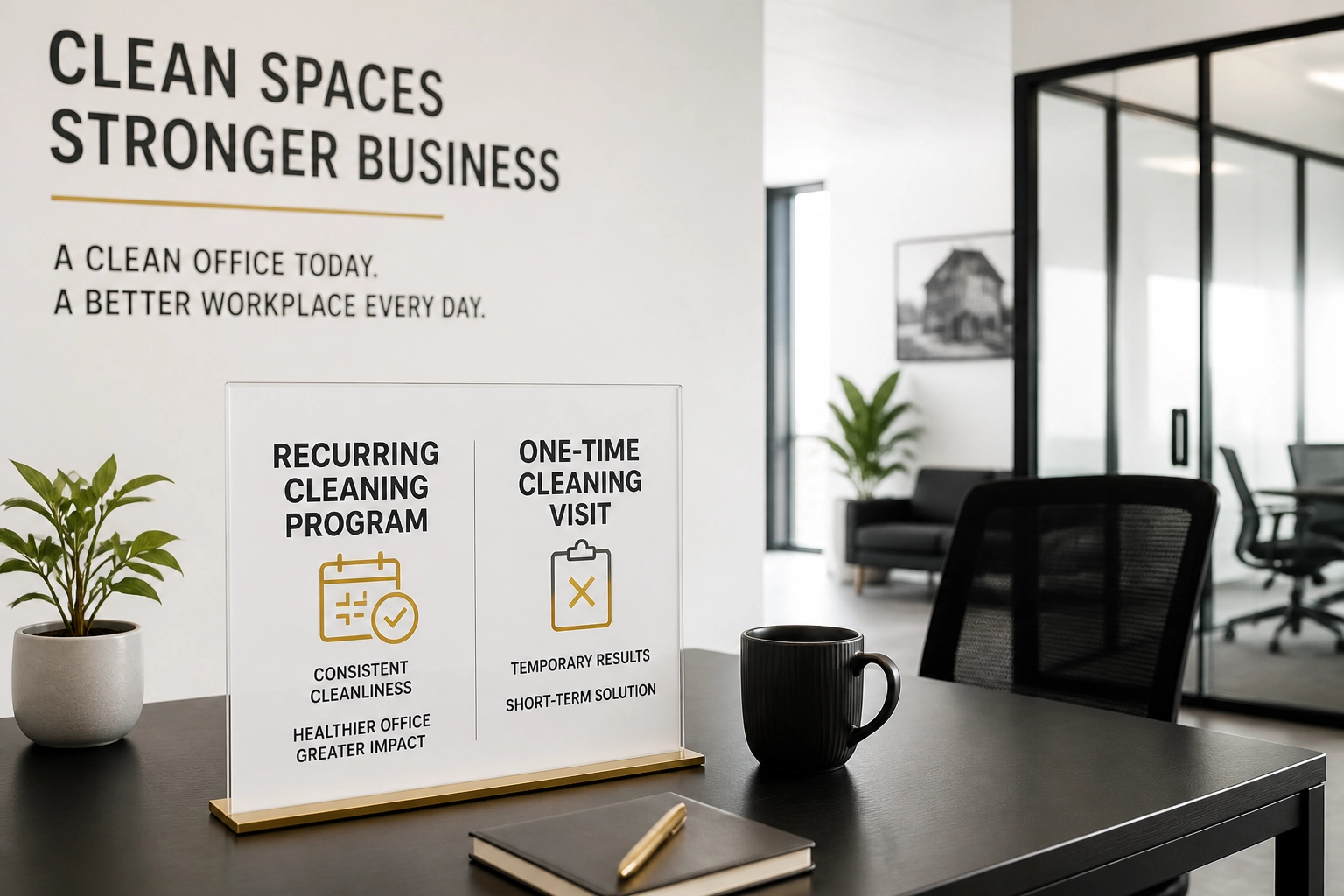
Most Lancaster County offices don't have a cleaning problem. They have a cleaning strategy problem.
There's a meaningful difference between calling a cleaning company when things get out of hand and building a structured program that keeps your facility consistently maintained. Yet many businesses treat these two approaches as interchangeable, and the results show it: inconsistent appearances, accumulating grime between visits, and costs that quietly climb over time.
Commercial cleaning in Lancaster, PA works best when it's built on scheduled, recurring service rather than reactive, one-time visits. The reasons go beyond surface-level cleanliness. A properly structured recurring program protects your professional image, supports employee health and productivity, and extends the life of your facility. A one-time visit, by contrast, addresses what's visible today without preventing what builds up tomorrow.
This post breaks down exactly what separates recurring commercial cleaning from on-call service, why the distinction matters specifically for Lancaster County offices, and how to evaluate whether a cleaning vendor is actually equipped to deliver consistent, long-term results. If your current approach relies on ad-hoc visits, what follows will reframe how you think about facility maintenance entirely.
Recurring Commercial Cleaning and One-Time Service Are Not the Same Product
Recurring commercial cleaning and one-time service solve different problems. Confusing them leads to inconsistent results, higher costs, and facilities that never quite reach a professional standard.
A recurring commercial cleaning program is a structured maintenance arrangement: fixed schedule, facility-specific scope of work, assigned team, and documented quality standards. It is designed to prevent accumulation. A one-time visit is reactive, resetting a space that has already fallen below an acceptable threshold. Both have legitimate uses. Post-construction cleanup, move-out cleaning, and post-event restoration are exactly what one-time service is built for. Maintaining a functioning office is not.
The distinction runs deeper than frequency. Vendors structured around recurring programs build their entire operation around continuity: consistent staffing, scheduled routing, quality checkpoints, and growing familiarity with each facility they serve.
For most commercial environments, including offices, schools, medical clinics, and retail spaces, the pace of daily use simply outpaces what sporadic cleaning can address. Foot traffic, shared surfaces, restrooms, and breakrooms generate contamination continuously. A periodic visit can recover lost ground temporarily, but it cannot hold a consistent standard.
That gap is what this piece examines. What does a well-structured recurring program actually include? And why does that structure matter specifically for offices in Lancaster County, where professional presentation and operational consistency are tied directly to how local businesses compete and grow?
What a Recurring Commercial Cleaning Program Actually Looks Like
A recurring program has four concrete components: a fixed service schedule (daily, weekly, bi-weekly, or a custom frequency matched to your facility's traffic), a facility-specific scope of work, a consistent assigned team, and accountability checkpoints that confirm work is completed to standard.
It starts before the first cleaning visit. A structured vendor conducts a walkthrough of your space, identifying high-traffic corridors, restroom usage patterns, breakroom conditions, and any operational constraints like after-hours access or sensitive areas. That walkthrough produces a documented cleaning plan built around your office's actual layout and hours, not a generic template.
A one-time visit works differently. Without prior knowledge of your facility, the cleaner follows a general checklist. Nothing is calibrated to your specific soil patterns, traffic volume, or priorities. The job gets done, but the result reflects effort applied broadly rather than precision applied where it matters.
For a typical Lancaster County office, a recurring scope of work covers:
Workstations: surface wiping, keyboard and monitor cleaning, trash removal
Conference rooms: table and chair surfaces, whiteboards, high-touch areas
Restrooms: full sanitizing on every visit, consumable restocking
Breakrooms: appliance exteriors, counters, sink, floor
Lobbies and entry areas: floors, glass, seating surfaces
High-touch protocols: door handles, light switches, shared equipment, per CDC guidance on high-touch surface cleaning
That level of customization matters for budget efficiency as much as cleanliness. A calibrated scope eliminates redundant effort in low-use areas and closes gaps in high-use ones, so office managers get consistent, predictable results without having to supervise the process.
Why One-Time Visits Leave Lancaster County Offices Exposed
Knowing what a structured recurring program looks like is only half the picture. The other half is understanding what happens when offices skip it.
Office environments generate contamination continuously. Foot traffic tracks in particulates, shared surfaces accumulate microbial load between uses, restrooms require frequent attention to stay sanitary, and breakrooms cycle through daily spills and debris. The CDC notes that cleaning high-touch surfaces regularly prevents the spread of germs and that impurities from accumulated soil reduce the effectiveness of disinfectants applied later. As established, a one-time visit resets rather than maintains.
The reactive model also carries a cost trap that's easy to miss. When an office calls for service because something looks visibly dirty, the threshold has already been exceeded. Routine weekly or bi-weekly maintenance would have prevented the buildup faster and at lower cost per visit. By the time the problem is visible, the scope of work is larger, the service window is longer, and the disruption to staff is more noticeable than it would have been under a consistent schedule.
Professional image compounds this risk. Lobbies, conference rooms, and common areas form first impressions for clients, visitors, and prospective employees. A space that fluctuates between post-service clean and gradual decline does not project a consistent standard, regardless of how thorough any individual cleaning was.
These are the reasons offices that have made the switch to structured recurring programs rarely go back to ad-hoc arrangements. The shift reflects practical experience: ad-hoc arrangements transfer the burden of quality management back to the office manager, while a scheduled program removes it.
The Business Case for Scheduled Cleaning in Lancaster County Offices
The risks of reactive cleaning point to something larger: what a facility loses when cleaning is treated as optional rather than operational.
In our experience, flooring and hard surfaces show accelerated wear when soil and grit are left to accumulate between visits. Scheduled cleaning removes abrasive buildup before it degrades materials, extending the service life of assets that are expensive to replace. That makes recurring service a maintenance investment with a measurable return, not a line item to cut when budgets tighten.
There is also a workforce dimension. A consistently well-maintained office signals to employees that their environment is managed with care. That signal affects morale and reduces the frequency of illness that spreads through shared surfaces and common areas.
For Lancaster County businesses that depend on in-person client relationships, presentation is part of the product. Any professional services office cannot afford a lobby or conference room that looks like it was last cleaned "whenever someone called." Clients draw conclusions from what they see, and those conclusions attach to your brand.
The cost structure reinforces the case. Recurring programs carry a predictable monthly rate; one-time reactive visits typically involve larger scopes because accumulated soil requires more intervention, which tends to make individual visits more costly. Add the hidden cost of premature facility wear from inconsistent maintenance, and the total cost case for scheduled service is worth examining against your current reactive spend.
In a county where locally owned businesses and established professional corridors compete on reputation as much as service, consistent presentation is not a luxury. It is a competitive baseline.
Recurring Program vs. One-Time Visit: A Practical Comparison
The business case is clear. Here is how the two service models compare across the factors that matter most to facility decision-makers.
Factor | Recurring Program | One-Time Visit |
|---|---|---|
Purpose | Maintains a consistent baseline continuously | Resets a space that has fallen below an acceptable threshold |
Vendor Knowledge | Team learns the facility over time, including layout, priorities, and operational quirks | Starts from zero on each visit; no accumulated familiarity |
Cost Structure | Predictable monthly rate; easier to budget | Variable cost tied to the accumulated condition of the space at time of service |
Accountability | Ongoing performance incentives; regular client touchpoints create natural feedback loops | Job ends at completion; limited mechanism for follow-up or quality review |
Results Over Time | Steady, professional standard maintained consistently | Peaks immediately after service, then declines gradually until the next visit |
That last row deserves emphasis. The peak-and-decline cycle of one-time cleaning is not just an inconvenience; it actively works against a facility. Each period of accumulation between visits puts more stress on surfaces, requires a heavier service scope to correct, and creates windows where the space falls short of the standard your clients and staff actually experience.
A recurring commercial cleaning program eliminates that cycle entirely. The space does not recover from neglect; it never reaches neglect in the first place. For Lancaster County offices where professional presentation is a daily operational requirement, that distinction is the difference between managing a cleaning problem and removing it from the list of things you have to manage at all.
How to Tell If a Cleaning Vendor Is Actually Built for Recurring Service
Knowing a vendor can clean an office is different from knowing they're built to clean it reliably, week after week. These five questions separate vendors structured for recurring service from those better suited to one-time work.
Do they conduct a walkthrough before the first visit? A recurring-service vendor treats the initial facility assessment as a prerequisite, not a formality. They document a scope of work, identify priority areas, and set expectations before a single mop hits the floor. If a vendor is ready to schedule without seeing the space, that's a signal.
Do they assign a consistent team? Recurring service depends on institutional knowledge. The same lead cleaner or crew learns your layout, your quirks, and your standards. That familiarity reduces errors and eliminates the need for you to re-explain priorities every visit.
What does their communication look like between visits? Look for proactive protocols: schedule confirmations, a named point of contact, and a clear process for reporting issues or adjusting the scope. A phone number to call when something goes wrong is not a communication standard.
How do they document quality? Vendors built for recurring relationships track completed tasks and have a mechanism for client feedback between visits. The client shouldn't be the only quality-control checkpoint.
Can they customize the scope to your facility? A commercial cleaning company serving Lancaster, PA offices should be able to build a plan around your square footage, your schedule, and your operational priorities. Pre-packaged tiers are a one-time service mindset applied to a recurring service context.
Moving from Ad-Hoc Cleaning to a Recurring Program: What to Expect
Once you've confirmed a vendor is structured for recurring service, the actual transition moves quickly. Here's what the process typically looks like for Lancaster County offices making the switch from sporadic or on-call cleaning.
Most programs begin with an initial deep clean. If a facility has been maintained inconsistently, that first visit brings surfaces, restrooms, breakrooms, and common areas to a reliable baseline. Recurring maintenance is designed to preserve a standard, not recover from accumulated neglect, so starting from a clean slate is essential.
The scoping conversation that follows covers frequencies, access requirements, and any special-handling areas, producing a written plan tailored to your space rather than a generic checklist.
The first few recurring visits function as a calibration period. The team identifies anything the initial scope underestimated, adjusts timing, and refines priorities. Client feedback during this window is particularly useful. A good vendor actively solicits it rather than waiting for a complaint.
After that adjustment phase, the program largely runs itself. Schedules are set, the team knows the space, and office managers are free to focus elsewhere. Cleaning stops being something that requires ongoing coordination and becomes a reliable background function.
The Right Cleaning Program Protects More Than Your Floors
Once the program is running, the day-to-day management largely takes care of itself. But the decision that gets you there matters.
As the comparison earlier in this piece shows, recurring programs deliver consistent presentation, predictable costs, and a vendor relationship built around your facility, none of which a one-time visit can replicate.
If you're unsure whether your current arrangement meets that standard, the vendor criteria covered earlier offer a practical starting point.
If the answer to any of those is unclear, it may be time to reassess.
Haley's Cleaning Service works with offices, property managers, and business owners throughout Lancaster County to build customized recurring cleaning programs suited to their facilities and schedules. Contact us to discuss what a consistent, accountable program would look like for your space.
Lancaster County businesses deserve a cleaning partner invested in the long term, not one that shows up once and moves on. That's the difference we're here to provide.
Conclusion
Recurring commercial cleaning is a practical operational standard for Lancaster County offices that need to maintain consistent presentation, control costs, and build a vendor relationship that actually serves the business.
Haley's Cleaning Service builds customized recurring programs for offices and businesses throughout Lancaster County. Contact us today to discuss a cleaning schedule designed around your facility, your team, and your standards. A cleaner, more professional workplace starts with the right long-term partnership.
Want it done right?
Residential and commercial cleaning across Lancaster County. Free estimate in 24 hours.
Get a quote