Why Standard Janitorial Cleaning Falls Short for Lancaster County Gyms
Gym cleaning services for Lancaster County fitness facilities. Learn why standard janitorial fails and what fitness-specific cleaning actually requires.
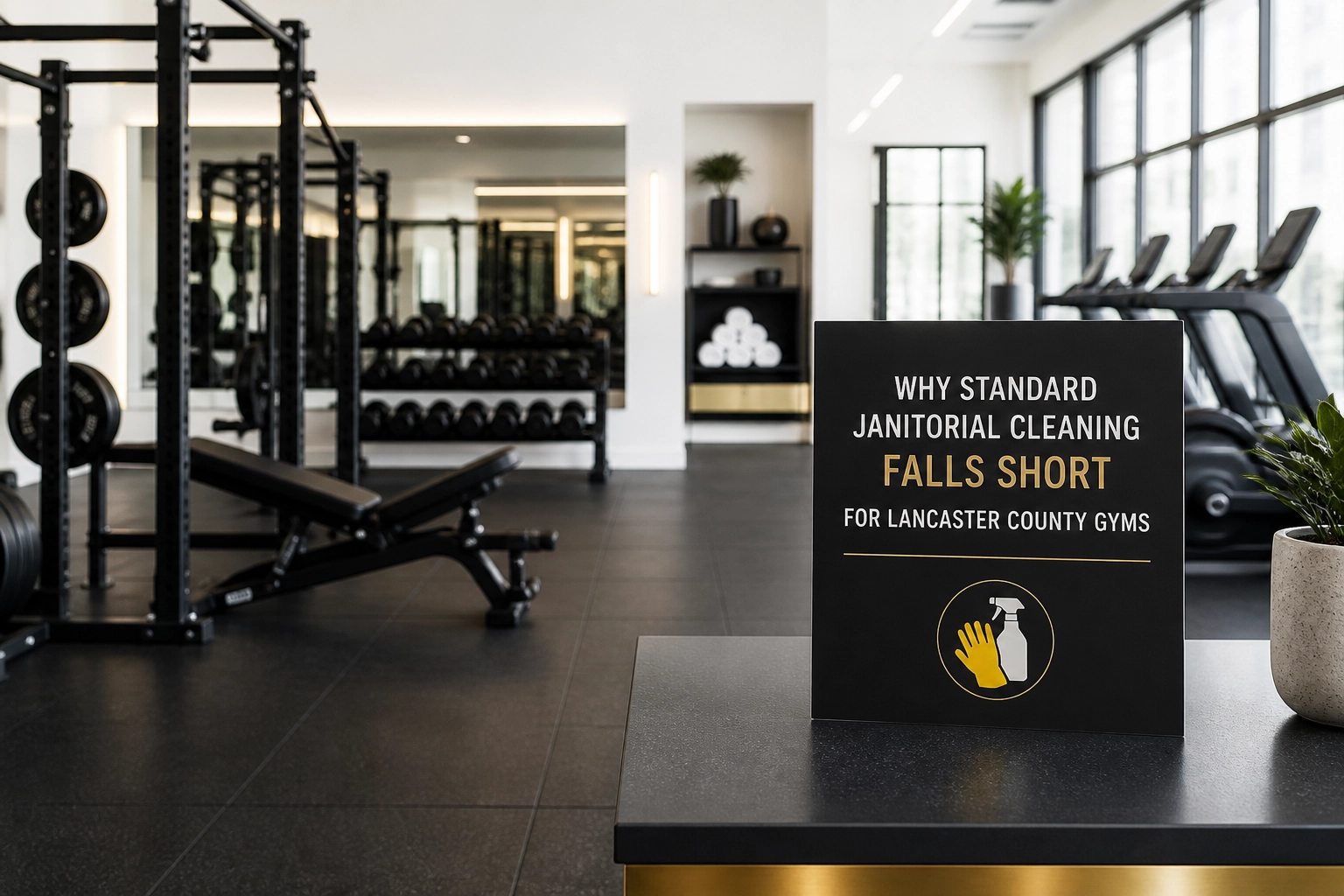
Every gym owner knows the feeling: a member complains about an odor in the locker room, equipment handles feel grimy despite being wiped down, and somewhere in the back of your mind, you wonder whether your current cleaning vendor is actually equipped for this environment. The truth is, most are not.
Standard commercial janitorial services are designed for offices, retail spaces, and common areas where cleaning demands are predictable and relatively low-intensity. Fitness facilities operate in an entirely different category. Continuous foot traffic, high-touch equipment, porous flooring, and humidity-heavy zones create conditions that overwhelm general cleaning routines and open the door to persistent odor, equipment degradation, and member health risks.
For Lancaster County gym owners and facility managers, the gap between adequate and inadequate gym cleaning services carries real consequences, from member retention losses to reputational damage that spreads quickly in a competitive local market. This post breaks down exactly where standard janitorial programs fall short, what fitness-specific cleaning protocols actually address, and what to look for in a cleaning partner who understands the unique demands of your facility.
The Gap Between Standard Janitorial and Gym-Specific Cleaning
Standard commercial janitorial contracts are built around predictable environments: office suites, retail floors, and lobbies where surfaces see moderate traffic and cleaning needs follow a reliable pattern. A nightly visit works well when the most-touched surface is a door handle. It does not work when the same piece of equipment cycles through dozens of sweaty hands before lunch.
Fitness facilities operate on a fundamentally different contamination timeline. Equipment is touched, coated in perspiration, and reused within minutes, creating a microbial load that accumulates continuously throughout the day. CDC guidance on athletic facility hygiene recommends cleaning shared equipment after each use, a standard that a once-nightly janitorial rotation cannot meet by design.
The pathogen stakes are also higher than in a typical commercial setting. The CDC notes that approximately 30% of the general population carry Staphylococcus aureus on their skin, a bacterium that transfers readily through contact with shared surfaces. Multiply that baseline across every member who uses a bench, cable handle, or locker room floor in a single day, and the exposure profile looks nothing like a shared conference table or office lobby.
For Lancaster County gym operators, the gap between standard janitorial and fitness-specific cleaning usually becomes visible too late: after a member complaint surfaces, after persistent odor resists repeated treatments, or after equipment shows premature wear that no single cause obviously explains.
High-Touch Equipment Demands a Different Disinfection Frequency
The problem intensifies when you look at what actually happens on a fitness floor during peak hours. A single cardio machine, bench, or cable station can be contacted by multiple members within a short window, each transferring sweat, skin cells, and bacteria onto handles, pads, and screens.
Many facilities respond by posting wipe-down stations and signage near equipment. Facilities that pair visible signage with accessible wipe-down stations tend to see higher member participation in between-use cleaning, but member compliance, however improved, is not a substitute for professional disinfection protocols. Members are not trained in dwell times, product selection, or cross-contamination risk. They wipe and move on.
That distinction matters beyond hygiene. When a facility delegates disinfection responsibility to members, it effectively shifts liability onto people who lack the training, equipment, or motivation to perform it at a clinically meaningful level. If a member develops a skin infection traceable to shared equipment, the facility's defense is significantly weaker when its cleaning program consists of spray bottles and paper towels next to the treadmills, a point worth keeping in mind as you structure a formal program.
Disinfectants must remain wet on a surface for a specified contact time to achieve the kill claims on their labels. Rushed members and undertrained janitorial staff routinely skip this step, wiping surfaces dry almost immediately. The result looks clean but provides no meaningful protection. Proper dwell-time management is one of the clearest separators between cosmetic cleaning and disinfection that actually works.
Surface Compatibility and the Hidden Cost of Wrong Cleaning Products
The frequency problem covered above is compounded by what cleaning products are actually applied. A gym floor contains an unusually diverse mix of surfaces: vinyl upholstery on benches and pads, powder-coated steel frames, rubber grips and flooring, chrome components, and LCD touchscreens. Each material has distinct chemical tolerances, and general-purpose disinfectants are not formulated with that complexity in mind.
Quaternary ammonium compounds, bleach solutions, and high-concentration alcohol products are legitimate disinfectants. In office or retail environments, they perform well. On gym equipment, repeated exposure tells a different story. Bleach and harsh alkaline solutions can crack and discolor vinyl over time. Chloride-based products cause pitting on chrome and stainless steel. Solvents and strong bleach degrade rubber. Touchscreens and electronics require products specifically evaluated for those surfaces. None of this damage appears overnight, which is exactly why it goes unnoticed until it becomes expensive.
The cost rarely gets traced back to the cleaning product. A cracked bench pad gets reupholstered. A corroded cable housing gets replaced. A touchscreen display starts malfunctioning. Facility managers absorb these costs as normal maintenance without connecting them to the disinfectants a cleaning crew has been applying three times a week for two years.
Specialized gym cleaning services approach product selection differently. Disinfectants are matched to surface type, verified for efficacy against relevant pathogens, and evaluated specifically for safety under repeated use on vinyl, rubber, and metal.
For Lancaster County fitness facilities carrying significant equipment investments, this is not an upsell. Protecting commercial-grade equipment from preventable chemical damage is straightforward stewardship of an asset you have already paid for.
Locker Rooms, Humidity Zones, and Where Mold Gets Its Foothold
Surface compatibility determines what happens to equipment. What happens inside locker rooms determines what happens to your members and your facility's reputation.
Locker rooms, shower areas, and saunas share an environmental profile that has no equivalent elsewhere in a fitness facility: sustained humidity, porous surfaces, and a continuous deposit of organic material including hair, skin cells, and soap residue. OSHA recognizes mold as a documented workplace hazard precisely because these conditions, moisture plus organic food sources plus oxygen, produce microbial growth that is both predictable and preventable.
The surface challenge here is distinct. Tile grout, rubber flooring, and unsealed concrete are not smooth, wipeable materials. Microbial colonies establish inside the pores of these surfaces, not just on top of them. Reaching those colonies requires antimicrobial products formulated for penetration and dwell times long enough for the chemistry to work. Running a mop across a locker room floor at standard janitorial speed does not accomplish either.
Standard janitorial routines compound the problem by ignoring ventilation zones entirely. Exhaust vents, drain covers, and ceiling fixtures in high-humidity spaces are where mold colonizes first, well before it becomes visible to a member walking through. Inspecting and cleaning those components requires deliberate protocol. General commercial cleaners rarely include it in their scope.
Persistent locker room odor is the most misread symptom in a fitness facility. Operators frequently attribute it to inadequate airflow and respond by running exhaust fans harder. In most cases, the odor traces to active microbial growth inside porous surfaces or biofilm accumulation in poorly maintained drains. Fans cannot resolve a biology problem.
A fitness-specific cleaning program treats humidity zones as a distinct category: matched antimicrobial products, enforced dwell times, and inspection protocols that identify early-stage mold before it requires remediation rather than cleaning.
Member Health, Retention, and the Reputational Stakes of Getting Cleaning Wrong
The environmental risks covered above translate directly into member-facing consequences, and those consequences move faster than most facility operators expect.
When members encounter persistent odors, grimy equipment, or skin irritation, the most likely outcome is quiet attrition, a cancelled membership and, increasingly, a public review. In a geographically contained market like Lancaster County, patterns of cleanliness complaints can compound quickly because the prospective member pool is shared and finite.
The liability dimension compounds that risk. Facilities that cannot demonstrate a documented, gym-specific cleaning program face harder questions if a member health complaint escalates, whether in a formal complaint or a public review.
This is why the case for specialized gym cleaning services is ultimately a business argument as much as a health one. Professional-grade disinfection, applied on a schedule tied to actual usage patterns and documented with verifiable protocols, removes the operational exposure that comes with treating a fitness facility like any other commercial account.
When evaluating cleaning vendors, decision-makers at Lancaster County gyms should press on three specific areas: disinfection frequency relative to peak usage hours, product-to-surface compatibility documentation, and locker room protocols beyond basic mopping. A vendor with genuine fitness-facility experience will answer those questions with specifics. One without it will not.
What a Fitness-Facility Cleaning Program Actually Looks Like
Knowing what questions to ask is a starting point. Understanding what a well-built program actually contains is what separates a capable vendor from one that will simply repeat the problems you already have.
A fitness-facility cleaning program begins with a site-specific assessment, not a templated scope copied from an office account. Facility hours, floor plan, member volume, peak usage windows, and surface inventory all shape what the program requires. A boutique studio in Landisville operates differently than a full-service gym in Lancaster City, and the cleaning program should reflect that difference precisely.
From that foundation, the program establishes zone-based protocols with defined disinfection checkpoints. The fitness floor, free weight stations, cardio equipment, locker rooms, restrooms, and common areas each carry distinct contamination profiles and require distinct approaches. Checkpoints align with actual usage patterns, including morning rush and evening peak periods, rather than defaulting to a single nightly visit.
Product selection is deliberate, not default. Disinfectants are matched to the surfaces they contact and verified for pathogen efficacy. Dwell times are observed, ensuring the product actually performs rather than being wiped off before it takes effect. This discipline protects both members and the equipment surfaces themselves.
Recurring gym deep cleaning services address what routine visits accumulate over time: locker room floor scrubbing, grout treatment, drain maintenance, ventilation component cleaning, and equipment detailing. These services run on a scheduled cadence tied to facility usage, not only when a problem becomes visible.
Haley's Cleaning Service builds customized cleaning programs for fitness facilities throughout Lancaster County, structured around each facility's specific schedule, surface inventory, and operational needs. The result is a documented, consistent program that gym operators can rely on and, when needed, point to.
The Right Cleaning Partner Makes the Difference
That distinction matters when you are evaluating your options. A fitness facility is a different operating environment entirely from the offices and retail spaces that general janitorial contracts are engineered for, and expecting a general cleaning contract to perform at the same level is the wrong framework from the start.
For gym operators in Lancaster County, the stakes are concrete: equipment that represents a significant capital investment, members whose health and loyalty depend on a genuinely clean environment, and a local reputation that can be damaged faster through a string of Google reviews than through any marketing misstep.
When evaluating any cleaning vendor, ask four direct questions:
Do you have documented experience cleaning fitness facilities specifically?
How do you structure disinfection frequency around peak usage periods, not fixed nightly schedules?
How do you verify that your product selection is compatible with vinyl, rubber, powder-coated steel, and LCD surfaces?
What is your locker room protocol, including drain maintenance, grout treatment, and ventilation inspection?
A vendor with genuine fitness-facility experience will answer these without hesitation. One without it will generalize.
Haley's Cleaning Service provides commercial gym cleaning services and gym deep cleaning services for fitness facilities throughout Lancaster County and surrounding Central Pennsylvania communities, including Lancaster, Landisville, East Petersburg, Mountville, and Rohrerstown.
If your current cleaning program wasn't built for a gym environment, it's worth a conversation. Contact Haley's Cleaning Service to request a consultation and learn what a customized, fitness-specific cleaning program looks like for your facility.
Conclusion
A gym cleaning program that wasn't built for a fitness facility is, by definition, built for something else.
If your current program wasn't built for a gym, it's time to change that, contact Haley's Cleaning Service to start the conversation.
Want it done right?
Residential and commercial cleaning across Lancaster County. Free estimate in 24 hours.
Get a quote