Step 6: Read a Commercial Cleaning Contract and Price Sheet
Compare commercial cleaning contracts before you sign: pricing structure, escalation clauses, add-on triggers, cancellation, and supplies included.
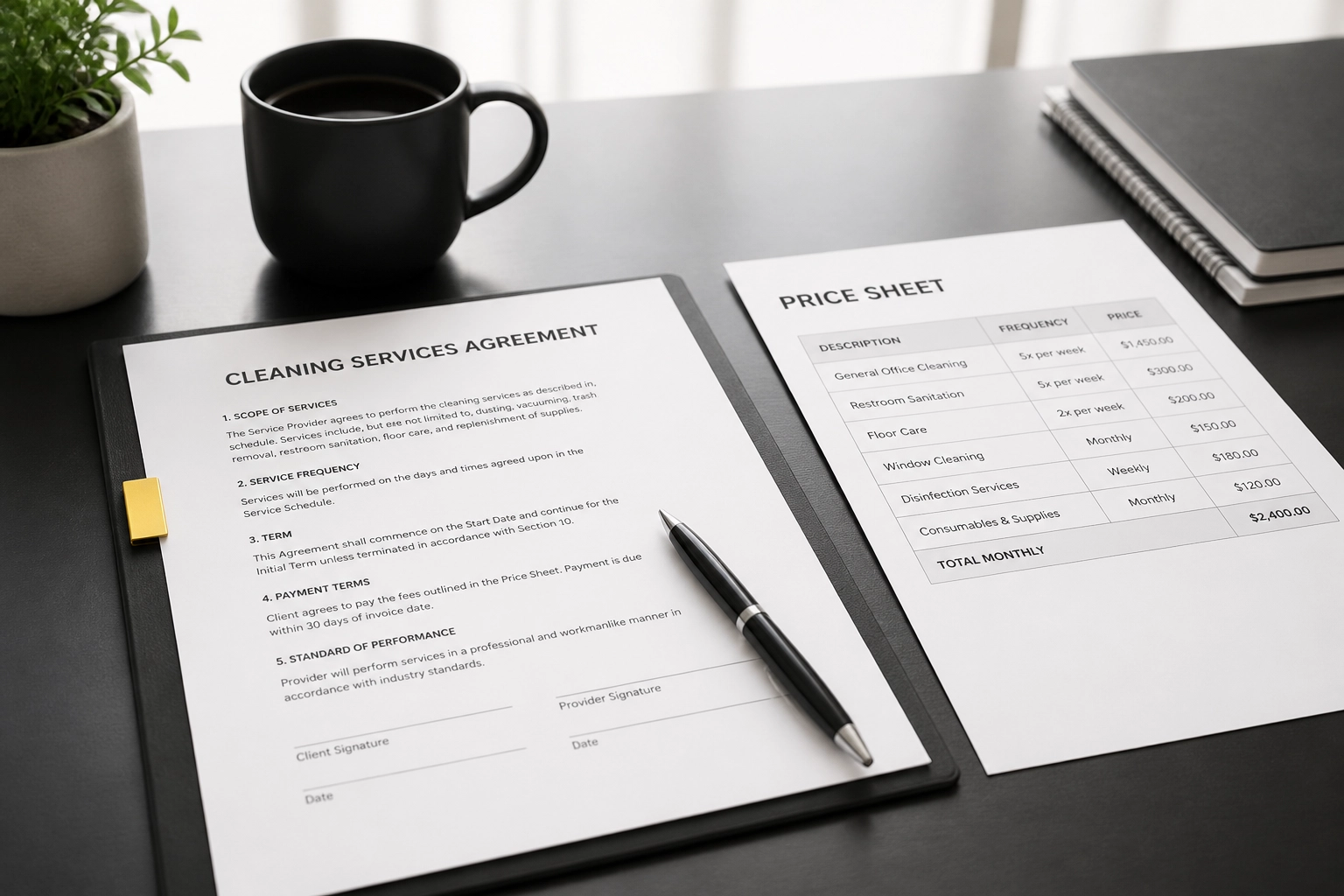
Most Lancaster buyers go straight to the bottom-line number and skim the terms. It is an understandable habit, but it is also where budgets quietly go sideways. A commercial cleaning contract is only comparable once scope, frequency, and exclusions are normalized, and that means reading the document clause by clause, not just the total at the end.
This post walks you through that read. You will learn why the bottom line is not the price, how the three pricing structures, per-visit, flat monthly, and per-square-foot, do not compare on their own, and how escalation clauses can move your costs mid-contract. We will cover add-on triggers that quietly create new line items later, cancellation windows and early-termination fees, and what "supplies included" actually covers. You will also get a scope-normalization checklist and a worked example that puts two quotes side by side, so the cheapest quote stops looking cheapest.
If you manage facilities in Lancaster County and want proposals built on documented quality standards, dependable scheduling, and customized plans rather than price alone, this is the groundwork that makes those conversations productive.
Why the Bottom Line Is Not the Price
The number at the bottom of a commercial cleaning proposal is the least useful number in the packet. A price without a defined scope is a guess, not a quote.
Picture two hypothetical proposals for the same 8,000-square-foot Lancaster County office. One includes restroom consumables, nightly trash removal, and quarterly carpet work. The other lists all three as excluded, or never mentions them at all. That gap can run hundreds of dollars a month, and the lower figure is not cheaper. It is simply smaller.
A commercial cleaning contract becomes comparable only once scope, frequency, and exclusions are normalized. This step teaches that normalization: pricing structures (per visit, flat monthly, per square foot), escalation clauses, add-on triggers, cancellation windows and early-termination fees, what "supplies included" actually covers, and a scope-normalization checklist you can run against any proposal.
For the broader vendor evaluation sequence, see Step 6: Review Contract Terms and Pricing Transparency, and explore our commercial cleaning services for context on scoped plans.
One honest note: this is a buying guide written by a cleaning company, not legal advice. Have your own counsel review any long-term or high-value business cleaning contract before you sign.
The Three Pricing Structures, and Why They Do Not Compare
Pricing structures are the second layer of the comparison problem. A per-visit proposal charges for each service occurrence. Before trusting that number, confirm how many visits per month it assumes, whether after-hours or weekend work carries a premium, and whether travel time is built into the rate or added later. Flat monthly pricing appeals to anyone building an annual budget, but it hides assumptions: "monthly service" can mean four visits in one proposal and five in another, and the flat fee can mask a lighter task list per visit. Per-square-foot pricing is a recognized industry benchmark format, yet the rate alone says very little, because labor is driven by restroom fixture counts, floor types, occupant density, and the task list, not square footage by itself. Mixing structures breaks comparison entirely: a per-square-foot proposal and a flat monthly proposal can land within dollars of each other while covering very different amounts of work per visit. Three questions make any structure readable: what is included on each visit, how many visits are included per period, and what is excluded from the price you were given. Answer those consistently across quotes, whether you are weighing a recurring program against one-time visits or comparing two recurring plans, and the numbers finally measure the same job.
Escalation Clauses: What Can Move Your Price Mid-Contract
Once you understand how a proposal is priced, the next question is whether that price can move after signing. In a commercial cleaning contract, an escalation clause is language that lets the price change during the term for defined reasons. These provisions exist to address shifting labor and supply costs, and they are not unique to cleaning.
Expect four common forms: a scheduled annual increase, a labor-cost pass-through, a supply-cost adjustment, and a cap or ceiling that limits how far any of those can move. To turn vague language into a known number, ask: Is the annual increase a fixed percentage or a set dollar amount? Is it tied to an index? How much written notice is required before it takes effect? Is there a cap?
Push back on open-ended phrases such as “prices subject to change” with no defined trigger, no notice period, and no ceiling. That language leaves you unable to predict a 12- or 24-month cost. Ask what triggers a pass-through and whether increases are capped, then get the answer in writing before you sign.
Add-On Triggers That Add Line Items Later
Escalation language governs planned increases; add-on triggers govern the unplanned ones. An add-on trigger is any condition written into the commercial cleaning contract that turns an excluded task into an extra charge once it appears in daily operations.
Around Lancaster facilities, the usual triggers are restroom fixtures or floors beyond the quoted count, added square footage after a build-out, after-hours or post-event cleaning, seasonal deep cleaning, carpet extraction, hard-floor stripping and waxing, and consumable restocking past a set allowance.
Read overage language closely. It should state what usage level is included and the exact unit rate that applies once the job exceeds it, such as a per-restroom or per-square-foot rate. Without that, every extra is priced after the fact.
Before signing, request a written add-on rate card and ask whether those rates hold for the full term. An extra restroom, a new breakroom, or a tenant turnover in a property management portfolio can push a job past the quoted office cleaning contract scope. Knowing each trigger in advance is how a facility manager protects the annual budget and keeps contract cleaning prices predictable.
Cancellation Windows, Notice Periods, and Early-Termination Fees
With add-on rates settled, turn to the exit terms in the commercial cleaning contract. Ask whether the agreement auto-renews, when the opt-out window opens and closes, and how notice must be delivered: in writing, by email, or by certified mail. Notice periods of 30, 60, or 90 days are common, so confirm the exact day count and the exact date the clock starts. If an early-termination fee exists, learn how it is calculated: remaining months, a flat amount, or notice plus a final payment. Ask whether it still applies if you relocate or shrink your space. Then distinguish a scope change from a cancellation: request written confirmation that reducing visit frequency or square footage is a permitted modification, not a breach that triggers a fee. Finally, calendar the notice deadline the day you sign. Missing an auto-renewal window typically costs another full term. Our cancellation and rescheduling policy explains how Haley’s handles schedule changes.
What 'Supplies Included' Actually Covers
"Supplies included" is highly elastic in commercial cleaning contracts.
Three buckets, one phrase
Break it into consumables (paper products, soap, liners), equipment (vacuums, carts, mops), and cleaning chemicals. For each, ask who buys it, who stores it on site, and who pays for repair or replacement when equipment fails mid-term. These are separate answers, and the phrase rarely covers all three.
Overage and markup
Ask what happens when consumable use exceeds the quoted allowance. Is cost passed through at cost or marked up? Get the unit rate. "Included" is meaningful only if you know where it stops.
Product standards
Included supplies raise quality questions. Ask what product standards apply to restrooms, glass, and floors, and whether specific products can be written into the plan. Public janitorial specs often organize requirements by chemical, equipment, tool, and material categories, plus restroom and floor procedures, showing this detail can be contractual.
Comparison consequence
Where supplies are excluded, add an estimated monthly consumables figure to each proposal before comparing totals. That line often reverses the cheapest-looking proposal. Our office cleaning services in Lancaster page gives an inclusions baseline. Next, put all proposals on one visit count and task list with the scope-normalization checklist.
The Scope-Normalization Checklist
Once supplies language is settled, normalize every proposal against the same five dimensions before you compare a dollar figure.
Frequency: Put each proposal on identical visit counts per month, same days, same times.
Task list: Match restrooms, breakrooms, lobbies, private offices, stairwells, entrances, and trash handling line by line. Missing tasks become visible rather than assumed.
Exclusions: Write down what no proposal covers, including carpet extraction, high windows, exterior areas, and post-construction dust, so gaps are priced deliberately.
Facility facts: Square footage, restroom fixture counts, floor types, occupant density, and building access hours drive the labor behind every number.
Contract terms: Put supplies ownership, add-on rates, escalation language, cancellation windows, and notice deadlines in one column per vendor. This is where documented cleaning standards belong in writing, not in a verbal promise.
With every quote on the same page, the next section shows what changes.
Worked Example: Two Quotes, Normalized
Put that side-by-side view to work on a hypothetical Lancaster office: 8,000 square feet, two restrooms, a breakroom, a lobby, open office space, and five visits per week. Neither quote below is Haley's rate or a real client scenario; both are illustrative.
Quote A shows the lower headline number. It is priced per visit, excludes consumables, bills quarterly carpet extraction separately, carries a 60-day cancellation window, and states no cap on increases. Quote B carries the higher headline number but is flat monthly, includes consumables with two restroom restocks per month, allows 30-day notice, and caps its annual increase in writing.
Normalize both before comparing. Add a monthly consumables estimate to Quote A. Add the same two carpet extraction services a year to each. Confirm both include the same 20 monthly visits. Then compare monthly totals, not headline figures.
The pattern is common: once supplies and excluded task work are added back in, the cheapest commercial cleaning quote often lands above the other for identical work. The lowest number is a starting point for questions, not a decision.
Questions to Ask Before You Sign
Once both quotes are normalized, the deciding work shifts to the questions you ask before signing. Put these in writing, and keep the answers with the contract.
Ask each vendor to define "weekly" and "monthly" as exact visit counts, then confirm service days, arrival windows, and holiday coverage in writing.
Request the full task list by area with a frequency for each task, so the office cleaning contract can be read line by line against a competing proposal.
Ask what triggers an extra charge, the unit price for each trigger, and whether those rates hold for the full term.
Ask what can change the rate mid-contract, how much notice you will receive, and whether any increase is capped.
Confirm the auto-renewal date, cancellation window, and required notice method in writing, and clarify who supplies and pays for consumables at overage.
Pair this review with our guide to how to evaluate a commercial cleaning company before signing a contract.
Business owners, office managers, property managers, and facility teams in Lancaster, Landisville, East Petersburg, Mountville, and Rohrerstown can request a quote or consultation and receive a customized plan with a documented scope to compare against any other proposal.
Sign With the Whole Picture, Not the Bottom Line
With those answers in hand, the decision comes down to one disciplined comparison. Normalize every proposal to the same visit count, task list, and exclusions before you look at a dollar figure; until then, the numbers are not measuring the same job. Read escalation and add-on language before the price itself, since those clauses determine what you pay across the full term, not just on day one. Calendar cancellation and renewal deadlines the day you sign, and put supplies language, overage rules, and unit rates in writing. Then choose the commercial cleaning contract with the clearest scope, documented quality standards, and dependable scheduling, not the smallest opening number. That is how Luxury Residential Standards Brought to Commercial Spaces translates into a vendor relationship you can manage. If you want this comparison built for your Lancaster County facility, contact Haley’s Cleaning Service for a customized quote.
Conclusion
A commercial cleaning contract is more than a monthly number. Normalize every proposal to the same visit count, task list, and exclusions before comparing price. Read escalation, add-on, and cancellation language carefully, because those terms shape what you pay across the full term. Document supplies coverage, overage rules, and unit rates in writing. Then choose the provider with the clearest scope, documented quality standards, and dependable scheduling, not the smallest opening figure. Haley’s Cleaning Service helps business owners, office managers, and facility teams in Lancaster, Landisville, East Petersburg, Mountville, and Rohrerstown build customized plans with documented scopes they can compare against any other proposal. Request a quote or consultation and sign with the whole picture in view.
Want it done right?
Residential and commercial cleaning across Lancaster County. Free quote.
Get a quote