One Cleaning Program, Five Facility Types: What Changes
See how dwell time, chemistry, scheduling, and documentation shift across offices, banks, gyms, schools, and apartment common areas.
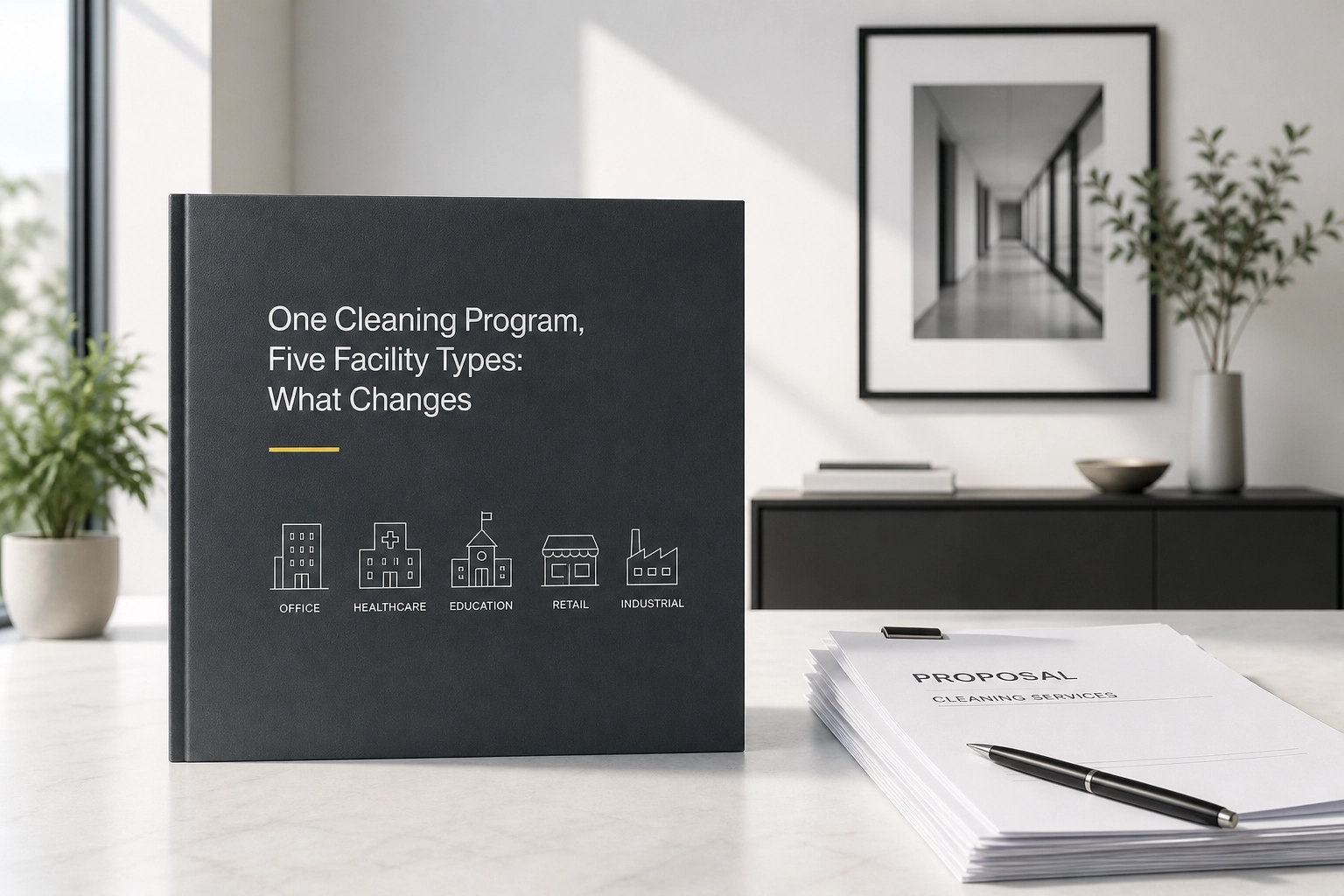
You have likely seen two commercial cleaning proposals that look almost identical, despite being for completely different buildings. That similarity is a red flag. A genuine facility-aware plan, not a copy-pasted template, makes concrete operational adjustments based on how your building is used. In Lancaster County and across Central Pennsylvania, the difference between a program built for your facility and a generic one shows up in dwell time, chemistry, scheduling windows, and documentation. This post breaks down exactly what should change across five facility types: offices, banks and financial branches, gyms, schools and churches, and apartment common areas. We will examine the three distinct actions of cleaning, sanitizing, and disinfecting, then walk through a four-dimension matrix that reveals whether a proposal was truly built for your property. You will also get an audit framework with specific questions to expose a copied template before you sign anything. At Haley's Cleaning Service, we build customized recurring cleaning programs around how each building is used. Request a consultation to see what a plan built for your building actually looks like.
Why Two Cleaning Proposals Look Identical and Should Not
Most commercial cleaning quotes arrive looking the same. The frequency options match. The task list matches. The line about "all surfaces" and "industry-standard products" could have been copied from the last proposal you reviewed. That sameness is the problem.
The differences that matter are not slogans. They live in four operational decisions: how long a product stays wet on a surface before it is wiped, which chemistry goes on which material, when the crew is allowed in the building, and what gets written down afterward. A plan built for an office, a bank branch, a gym, a school, and an apartment common area will answer those four questions differently because each building has different use, occupancy, and rules.
That is also the practical answer to "what is commercial cleaning." It is not one service copied from facility to facility. It is a set of adjustments made against one building's conditions. The term becomes useful only when a proposal shows those adjustments in writing. For a closer look at the warning signs, see why one-size-fits-all cleaning plans are a red flag.
This matters when you compare price per visit. A generic proposal can look competitive precisely because it answers fewer questions. It may not name products, state contact times, explain access procedures, or define documentation. Lower scope can look like lower cost.
This guide lays out a matrix for offices, banks, gyms, schools, and apartment common areas. The goal is to help you read a proposal the way the person who has to execute it would.
Cleaning, Sanitizing, Disinfecting: Three Different Actions
Clean, sanitize, and disinfect are not interchangeable words, and a proposal that treats them as synonyms has already told you how carefully it was written. The CDC defines each action separately: cleaning with soap or detergent removes germs, dirt, and impurities from surfaces; sanitizing reduces germs to levels that public health codes or regulations consider safe; and disinfecting kills most germs left on the surface. Cleaning alone removes most types of harmful germs. Each action is a step, not a substitute for the others.
The sequence matters more than the vocabulary. CDC guidance states that surfaces must be cleaned before they are sanitized or disinfected, because dirt and impurities can keep chemicals from ever reaching the germs they are meant to kill. A disinfectant applied over a sticky breakroom counter is not doing the job the label promises.
Surface type and touch frequency drive the rest. The CDC advises accounting for both, noting that high-touch surfaces are more likely to spread germs and that high-traffic areas may need more frequent cleaning or added disinfection. That is why high-touch equipment demands a different disinfection frequency than a lobby floor.
Two boundaries keep this honest. First, the CDC's facility recommendations are written for community settings such as offices, gyms, businesses, and community centers, and explicitly do not apply to healthcare settings or other facilities with their own regulations. Facility-specific rules get checked before any general template is applied. Second, dwell time is not a generic number. It comes from the product label for the EPA-registered product in use, so a genuine plan can name which product is applied and what contact time the label requires for your surfaces.
The EPA and CDC released joint cleaning and disinfecting guidance for public spaces, workplaces, businesses, schools, and homes on April 29, 2020, during COVID-19 reopening. Treat it as background on terminology, then confirm what your facility and local rules require today.
The Matrix: Four Dimensions That Should Change by Facility Type
Those distinctions only matter when a plan applies them building by building. A commercial cleaning proposal can be reduced to four dimensions that should shift by facility type: dwell time (how long a product stays wet before wiping or rinsing, per label and material), chemistry (which product goes on restroom fixtures, glass, laminate, upholstery, rubber gym flooring, electronics, and food-contact surfaces, and what is cleaned before disinfecting), scheduling window (when a crew is permitted and useful, whether after hours, before opening, between events, or in a low-traffic block), and documentation (room-level checklists, service logs, issue reporting, and who receives the record).
Dimension | Office | Bank branch | Gym | School/church | Apartment common areas |
|---|---|---|---|---|---|
Dwell time | Restroom and breakroom label contact time | Counter and customer-glass contact time | Equipment, mat, and locker-room contact time | Restroom, cafeteria, and entry contact time | Elevator, mailroom, and trash-room contact time |
Chemistry | Screens, laminate, fabric, glass | Customer glass, counters, restricted areas | Rubber flooring, vinyl, touchscreens, showers | Food areas, classrooms, multi-use rooms | Glass, package room, laundry, trash rooms |
Scheduling | After hours or early morning | Outside posted hours, escorted access | Midday pass plus close | After dismissal, between services | Low-traffic block, resident notice |
Documentation | Restroom/breakroom log, named contact | Time in/out, areas, sign-off | Zone checklist, locker log, issue report | Room-based list, event turnaround | Common-area log, per-unit punch list |
Read each cell as a question the proposal should answer for your building. When a proposal gives the same answers across all five facility types, it was not built for yours. Scheduling is rarely a clock-only decision; event-heavy sites need the calendar mapping described in Event-Day Turnarounds: The Hardest Scheduling Challenge in Facility Cleaning. The matrix is a conversation tool, not a replacement for your facility's own rules. Confirm requirements for licensed or regulated settings before committing to a plan.
Offices: Commercial Cleaning for Offices Is Occupancy-Driven
An office is defined less by square footage than by occupancy patterns. Desks get shared across shifts, breakroom appliances run all day, conference rooms turn over hourly, and the reception area is the first thing a guest sees. The commercial cleaning plan should reflect that rhythm rather than a generic room count.
Dwell time decisions concentrate where people cycle through fastest: restrooms, breakrooms, and shared touchpoints like door handles and appliance fronts. Ask which products are used there and what contact time the label requires before the surface is wiped, since a product wiped dry too soon is not doing the job the label promises.
Chemistry should match the material. Screens and electronics, laminate and wood veneer, fabric seating, and glass partitions each tolerate different products. Visibly soiled surfaces also need cleaning before disinfecting, because soil can keep chemicals from reaching the germs beneath it.
The scheduling window usually sits outside business hours or in early morning. That makes alarm codes, key or badge access, and a written procedure for an empty-building arrival part of the plan, not an afterthought.
Documentation for commercial cleaning offices comes down to frequency and accountability: restroom and breakroom service records, a named point of contact, and a clear path to report a missed area and get it handled. A branch faces tighter access rules still, which is where the next facility type begins.
Banks and Financial Branches: Access Rules Change Everything
A bank carries more procedural weight than an office, and access is where that weight shows. A branch mixes public lobby space with restricted areas, so the plan has to separate what can be serviced during open hours from what requires escorted or after-hours access. Teller counters, customer-facing glass, deposit areas, shared pens and counters, and private offices all raise dwell time and chemistry questions, especially where documents and equipment must not be disturbed. Ask what product goes on the glass and counters and what contact time the label requires before it is wiped.
Scheduling windows are often the tightest of any facility type. Service may need to fall outside posted hours, and the plan should state how access is granted, how entry is recorded, and how alarms and dual-control procedures are handled. The regulatory framework behind vendor access at banks sets expectations a proposal should already anticipate.
Confidentiality deserves its own questions: which crew members are assigned, whether they are consistent visit to visit, what they are instructed not to touch, and how questions get escalated to the branch manager.
Documentation should be specific, covering time in and time out, areas serviced, issues found, and sign-off. If a proposal offers a bank the same reporting it offers a gym, it was not tailored. A fitness facility plan can tolerate a flexible checklist. A branch cannot, because its record is tied to controlled access and confidentiality, not just cleanliness.
Gyms and Fitness Facilities: Sweat, Equipment, and Touch Frequency
Where a bank's challenge is access, a gym's challenge is volume and contact. Handles, benches, mats, dumbbells, cardio consoles, locker rooms, and showers are touched by dozens of members within a short window. That contact pattern, more than square footage, is what a fitness facility cleaning plan has to answer.
Sweat Is Soil: Clean Before You Disinfect
Sweat and body oils are soil that has to be cleaned off before disinfecting, so ask what is applied to rubber flooring, vinyl upholstery, and touchscreens. Some equipment manufacturers specify which products should and should not be used on their surfaces, and a plan that ignores those specs risks damaging the asset it was hired to protect. This is where standard janitorial cleaning falls short for Lancaster County gyms, because a generic restroom-and-floor routine does not account for equipment surfaces at all.
Touch Frequency Sets the Schedule
CDC guidance points toward more frequent attention on high-touch surfaces and allows for added disinfection in high-traffic areas. The plan should therefore state which zones get a mid-day pass and which are serviced at close. For most fitness facilities, that splits into a light mid-day visit and a heavier closing or overnight service, with locker rooms and showers running on their own rhythm rather than following the gym floor.
Documentation a Gym Manager Can Use
Look for an equipment and zone checklist, locker room logs, and a simple route for staff to report a spill or member complaint so it is addressed the same day. Without that route, the same bench stays sticky until the next scheduled visit.
Schools and churches share a different pattern entirely: long quiet stretches followed by sudden high occupancy.
Schools, Churches, and Community Facilities: Calendar-Driven Schedules
Gyms clean by contact volume. Schools, churches, and community centers clean by the calendar. These facilities sit quiet for long stretches, then fill all at once, whether that is a school day, a Sunday service, or a weekend event rental, and the plan has to hold up in both states.
Chemistry decisions have to respect food service areas, classrooms, and multi-use rooms where the same floor hosts lunch, art, and an evening meeting. For schools and childcare settings, state or local rules can govern which products are permitted and how they are applied, so a proposal should confirm those requirements before making any chemistry claim. A plan that leads with "hospital-grade" and never asks what applies to your building has skipped that check.
Dwell time matters most in restrooms, cafeterias, gymnasiums, and entryways, so the scope of work should state the clean-first-then-disinfect order explicitly rather than assume it.
Scheduling windows follow the calendar, not the clock: after dismissal, between weekend services, and around facility rentals. A plan built on dependable scheduling and consistent communication should show how it adapts when that calendar shifts, for example when a Friday night rental lands after a Thursday game and before Monday's opening.
Documentation should be room based, so a principal, church administrator, or community center director can see which spaces were serviced and when, including event turnarounds. Ask to see a sample report before you sign; it should name the rooms your building actually has, not a generic list.
Apartment Communities: Common Areas Plus Turnover Work
Schools and churches run on a calendar. Apartment communities run on leases, which means two cleaning jobs happen at once.
Common Areas: The Daily Impression
Residents judge the property by what they walk through every day. Dwell time and chemistry for elevators, mailrooms, package rooms, fitness rooms, laundry rooms, trash rooms, and lobby glass are set by touch frequency and visibility, not by a generic checklist. These are the high-touch, high-profile surfaces a property manager hears about first.
Turnovers Are Sequenced, Not Routine
A vacant unit is a different job. Kitchen appliances and cabinets, bathrooms, floors, windows, and odor treatment follow a sequence rather than a routine, and the work is usually finished against a punch list the property manager signs off on. What a professional apartment turnover clean actually includes goes well beyond surface wiping.
Scheduling is the tightest variable. Notice to residents, elevator protection, trash and recycling timing, and coordination with maintenance or painters all compete with the move-in and move-out dates that set the deadline. Documentation should include a per-unit turnover checklist, notes on anything found during the clean, and a clear handoff when the unit is ready to show.
The Proposal Audit: Questions That Expose a Copied Template
The five facility types above differ in purpose, occupancy, and risk, yet the proposal sitting on your desk may describe all of them in the same language. That is the moment to slow down. A plan built for your building will answer the following questions specifically, not generically.
The Core Audit Questions
Clean versus disinfect. Does the proposal name which surfaces it will clean and which it will disinfect, and explain why the two lists differ? The order is clean first, then disinfect. Use the CDC guidance on cleaning and disinfecting community facilities as a reference point when reviewing the sequence.
Products and contact time. Does it state which products are used and what contact time the label requires for your surfaces, or does it only say "hospital-grade" and "all surfaces"? The second phrase is not a specification; the label is.
Scheduling window. Does the window match your access rules, alarm procedures, and peak hours? A bank, a gym, and a school each require a different answer, and a plan that ignores your entry process is not built for your building.
High-touch frequency. Does it explain how frequency was set for your facility, citing traffic patterns and touch points, or does it quote a blanket daily rule? The setting should reflect your occupancy, not a default.
Documentation and accountability. Does it describe what records you receive, who signs off, and how quickly issues are resolved? Name the format and the response path.
People and contingencies. Does it name a consistent crew or point of contact, and a process for change orders, extra events, and illness reports? Ask how an illness report triggers a specific response rather than a vague promise.
Facility-type rules first. Does it ask about the rules that apply to your facility type before proposing chemistry or frequency? A provider who skips that step is applying a template.
Here is your simplest test. Swap your building's name for a different building type. If every answer still reads true, you are looking at a template, not a program. A genuine proposal changes when the building changes.
When you are ready to see what a plan built around your facility actually looks like, Haley's Cleaning Service walks each building in Lancaster County and surrounding communities before proposing anything. Request a quote or consultation to start.
What to Do With This Before You Sign Anything
The audit is only useful if it changes what you do next. Before you sign, apply it in four concrete ways.
Get the plan in writing by area. Ask for a room-by-room breakdown that names the products used and ties dwell time to the product label, not to a generic promise like "hospital-grade." If the plan cannot name the product and the required contact time, it is not a plan yet.
Match the scheduling window to your real access rules. Frequency is meaningless if the crew arrives when they cannot enter, or when your branch, school, or gym cannot accommodate them. Settle access, alarm, and peak-hour questions before you agree on how often service happens.
Require documentation you will actually read. A restroom log, a per-unit turnover checklist, or a branch sign-in record only matters if someone on your team reviews it. Specify the format, the recipient, and how quickly issues get resolved.
Revisit chemistry and frequency when your building's use changes. New tenancy, renovations, or a shift in occupancy can make a working plan outdated. Build a review point into the agreement so the program adjusts with the building.
Haley's Cleaning Service builds customized commercial cleaning programs for offices, banks, gyms, schools, churches, apartment communities, and post-construction work across Lancaster, Landisville, East Petersburg, Mountville, Rohrerstown, Centerville, and nearby Lancaster County communities. Request a quote or consultation and we will walk your building before proposing anything.
Conclusion
One cleaning program cannot be copied across facility types and still fit. The details that matter change with how a building is used: occupancy patterns, access rules, touch frequency, and calendars all shape what a plan should look like. Chemistry has to match the surface and the label, scheduling has to match your real access windows, and documentation only counts if someone reviews it. When your building's use shifts, the program should shift with it.
The next step is straightforward. Ask for the plan in writing, by area, with named products and dwell times, then compare it against your actual access rules and review habits. Haley's Cleaning Service walks your building before proposing anything, serving offices, banks, gyms, schools, churches, and apartment communities across Lancaster, Landisville, East Petersburg, Mountville, Rohrerstown, Centerville, and nearby Lancaster County communities. Request a quote or consultation and get a program built for your building, not borrowed from someone else's.
Want it done right?
Residential and commercial cleaning across Lancaster County. Free quote.
Get a quote