Switching Commercial Cleaning Vendors in Lancaster County Without a Service Gap
Changing commercial contract cleaning vendors in Lancaster County? Follow this step-by-step transition plan to avoid a service gap at your facility.
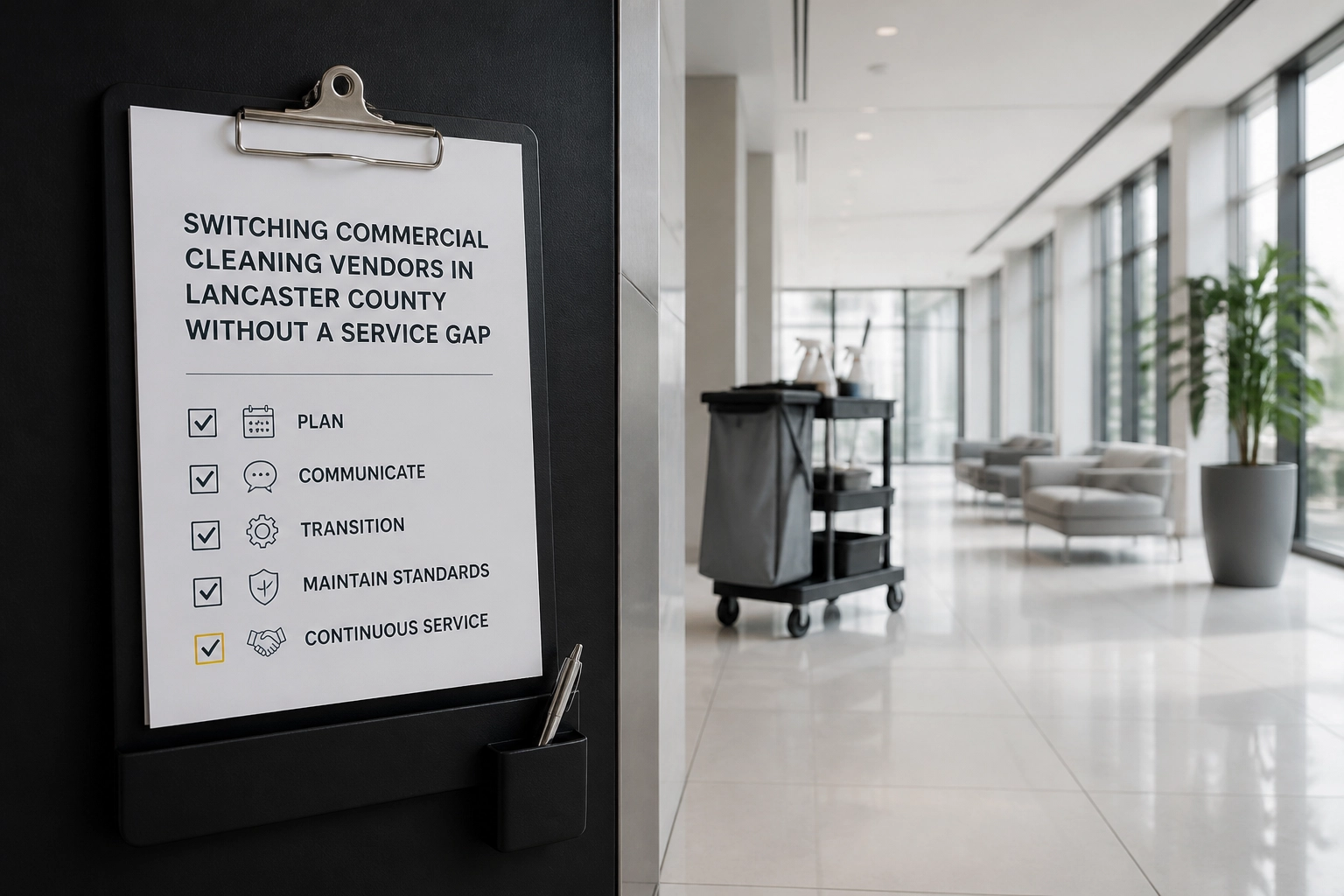
The riskiest part of changing cleaning companies is not the decision to leave your current provider. It is the gap between the last visit from the old crew and the first shift from the new one. Keys, access codes, alarm credentials, and quality baselines all have to change hands cleanly, or your building pays the price. Exiting a contract is an operations project, not a phone call, and for facilities that depend on recurring cleaning services, this window deserves a plan.
In this post, we will walk through the transition sequence step by step. We will cover how to document your current scope before notice goes out, work the notice period on your terms, transfer keys and alarm credentials without loose ends, and set a first 30-day quality baseline that gives your new provider something to hit. We will also address what to do if an outgoing vendor withholds records or walks off early, plus what paperwork to gather before the notice goes out and what belongs in your new commercial cleaning agreement.
Haley's serves offices, banks, property managers, apartment communities, schools, churches, and gyms across Lancaster, Landisville, East Petersburg, Mountville, Rohrerstown, and Centerville. If you are planning a switch and want a gap-free transition, reach out to request a quote or consultation.
Why a Vendor Switch Is an Operations Project, Not a Phone Call
The termination notice is not the exposure. The exposure is the window between the outgoing crew's final visit and the incoming crew's first, when no one clearly owns the building's condition. Three things must change hands in that window: physical and digital access, the written scope of work with its quality standard, and the building-specific knowledge that never made it into a document.
Treat the switch as a facility project with an owner, a timeline, a documented scope, and a definition of done. Most commercial contract cleaning agreements name a notice period and almost nothing about transition mechanics, so the plan is yours to write. Build clear communication into the vendor relationship from day one, because a handoff is only as good as the records behind it.
A gap rarely shows up as one dirty floor. It shows up as a credibility hit when tenants, employees, or customers notice the first messy Monday morning. Transitions also happen under pressure, often during a renewal dispute or a change in property management. That is exactly when sequencing gets skipped. Writing the sequence down before emotions are involved is your protection.
Step 1: Document Your Current Contract for Cleaning Before Notice Goes Out
Before you send notice, build the record the transition will run on. Walk the building yourself with the current scope document or contract for cleaning in hand. Do this before you notify anyone, because cooperation and information flow can change once notice goes out.
For each restroom, breakroom, lobby, entrance, stairwell, and common area, record whether it is cleaned daily, weekly, or monthly. Note where the recurring cleaning services cadence on paper differs from what actually happens.
List who supplies paper goods, soap, liners, and chemicals, where they are stored, and whether that arrangement ends with the cleaning contract.
Inventory vacuums, floor machines, carts, mop buckets, and storage closet contents, marking ownership. Equipment disputes can delay the first visit.
Photograph and date floors, carpet, grout, glass, and high-dusting surfaces. This baseline separates pre-existing conditions from new vendor performance later.
Capture badge and alarm protocols, after-hours rules, restricted rooms, recycling and shredding procedures, event or turnover coverage, and security-sensitive areas.
Record the start date, notice period, renewal or auto-renewal date, the contact named for notice, and any performance remedies in one place. Before comparing replacement proposals, use this guide to review contract terms and pricing transparency. Keep this packet with your access inventory and photos for candidate briefings.
Step 2: Work the Notice Period on Your Terms
With your scope documented, the notice itself becomes a scheduling document rather than a negotiation.
Send it in writing to the contact or address your cleaning contract specifies, keep proof of delivery, and log the sent date against the final service date the agreement requires. Then confirm the final weeks in writing: the last scheduled service day, whether full scope continues until then, what will and will not be done, and how keys and equipment return.
Decide deliberately whether to overlap service for a week or run a clean handoff date. Overlap reduces risk and adds short-term cost, and that trade-off should be a conscious decision rather than an accident.
Use the notice period to quote and onboard the incoming vendor so the first visit is scheduled before the last visit happens. A vendor chosen in the final week is a vendor chosen under duress. Request a closing walkthrough with your facility contact, plus any floor plans, checklists, or building notes the outgoing vendor can share, and ask for a final quality summary. Plan the handoff with the same written order of work that finish-trade sequencing requires on a construction handover.
Resolve final invoice and billing questions early and in writing rather than by phone, so a money dispute is not sitting beside a key return on the last day.
Keep every message procedural: dates, deliverables, next steps.
Step 3: Transfer Keys, Access Codes, and Alarm Credentials Cleanly
With the notice period documented and a first service date on the calendar, lock down access before anyone receives new keys. Build one written access inventory covering keys, fobs, badges, lockbox and gate codes, elevator and supply closet keys, alarm codes, and the named holder of each item.
Set a hard cutover day: deactivate or rekey the outgoing vendor’s credentials and issue the incoming vendor’s access the same day, so two live sets never coexist. Call the alarm monitoring company directly to update the authorized-user list, remove outgoing codes, and add the new site supervisor as a named contact with an after-hours phone number.
Require a written list of every outgoing crew member who held access, including floaters and weekend substitutes. Account for every key before closing the transition; if one cannot be returned, rekey that entry. Keep a one-page access log signed by the new site supervisor at handoff, photograph the inventory, and file both. That record answers future questions and supports the documentation every property manager should require from a turnover cleaning vendor.
Step 4: Reset a First 30-Day Quality Baseline
With access settled, the next handoff is the quality standard itself. Treat the first 30 days as a measurement window with agreed definitions, not a personality test. Two people can look at the same restroom and disagree about "clean" until the standard is written down. Before the first visit, put quality in writing: restroom cleaning and restocking frequency, trash removal timing, floor care, entry glass, breakroom surfaces, high dusting intervals, and every facility non-negotiable. A well-specified cleaning program leaves little room for interpretation, and that is the point.
Set a simple inspection rhythm: a weekly walkthrough with the site supervisor, a checkbox scorecard organized by area, and dated photos of anything that falls short. Consistency matters more than sophistication. Use your pre-switch photos to separate initial-condition problems from performance problems, which keeps the day-30 conversation factual rather than defensive.
Hold a formal day-30 review around three questions: what is working, what needs adjusting in the recurring cleaning services schedule, and what scope the facility has outgrown or no longer needs. Do not expand scope informally during the first month. Route every addition through the written plan so staffing, hours, and pricing stay aligned. Locally, a customized commercial cleaning plan built around facility size, schedule, priorities, and operational needs gives that 30-day baseline something measurable to stand on.
Step 5: When the Outgoing Vendor Withholds Records or Walks Off Early
That baseline protects quality once the new vendor starts. It does nothing if the outgoing vendor stops cooperating first. Plan for the contingency instead of hoping it will not happen: service may end early, crews may stop showing up, or scope documents, checklists, and condition notes may never arrive.
Rebuild the scope from records you already control. Your access inventory, your pre-switch photos, your staff's knowledge of which areas were cleaned when, and any inspection notes your team kept can reconstruct most of a working scope. Pair those with the documentation and accountability practices you already use on turnovers.
Put every records request in writing with a date, and keep a running log of what you asked for, what arrived, and what is still missing. A calm paper trail beats a phone argument.
If service stops before the contracted final date, document conditions daily with photos, times, and specific areas. That record protects you with the next vendor and in any billing discussion. When conditions degrade, pull the incoming vendor's start date forward; most transitions can compress by several days when scope is written and access is arranged.
Keep legal questions where they belong. Whether a withheld record triggers any obligation is jurisdiction-specific, so document your request, state the business impact, and route statute or entitlement questions to your own counsel. Then close the relationship professionally in writing. Continuity of service matters more than winning the exit, and a neat termination file serves your next cleaning contract far better than the last word.
What to Have in Hand Before the Notice Goes Out
Even with a contingency plan for a difficult exit, the stronger position is to assemble your commercial contract cleaning transition file before notice leaves your desk. Before you send anything in writing, gather:
A written scope of work covering areas, frequencies, and quality standards for recurring cleaning services. If the outgoing vendor never supplied one, build it this month from your walkthrough and staff input.
A complete access inventory listing each key, fob, badge, lockbox code, and alarm code, who holds it, how many exist, and the cutover date for deactivating old credentials and issuing new ones.
A contract summary page for your cleaning contract with the notice period, renewal or auto-renewal date, required notice method, and the exact contact or address the notice must reach.
A dated photo baseline of current conditions, plus a supplies and equipment list with ownership marked. For turnover areas, pair photos with a move-out checklist so expectations are documented.
A named internal transition owner and a backup, so approvals and walkthroughs do not stall on one calendar.
A target first service date and two or three vendors you intend to quote, contacted before notice goes out rather than after.
Alarm and monitoring contact details, including the company's process for changing the authorized-user list.
A small budget line for an overlap week and rekeying, the two costs that can surprise facilities mid-transition.
With that file assembled, the notice period becomes a controlled handoff rather than a scramble.
Building the New Commercial Contract Cleaning Agreement
With that packet assembled, the proposals you request should be as specific as the document you built. Ask every candidate for a written scope keyed to your facility's areas, frequencies, and cleaning windows, not a generic per-square-foot promise that never names your building. Confirm scheduling fit before signing: after-hours or early-morning access, weekend coverage, and event or turnover support for apartment communities, post-construction sites, and facilities with irregular traffic.
Ask how quality is documented and how communication works in practice. You want a named point of contact, a stated inspection cadence, and a clear answer for a complaint that arrives Friday afternoon. Ask what insurance and staffing practices each vendor carries, then verify coverage yourself; verbal assurance is not documentation.
Require the transition timeline inside the proposal: first service date, who performs the initial walkthrough, how the 30-day review is scheduled, and who signs the access log. Match the contract term and notice clause to how your facility operates, so the next change is planned rather than emergency.
Haley's Cleaning Service serves offices, banks, property managers, apartment communities, schools, churches, gyms, and builders across Lancaster, Landisville, East Petersburg, Mountville, Rohrerstown, Centerville, and nearby Lancaster County communities, with select commercial consideration in York and Harrisburg. Our approach brings luxury residential standards to commercial spaces. Compare proposals on that documented detail, then request a consultation built around your written scope.
Takeaways for a Gap-Free Vendor Transition
The new agreement sets expectations; the exit plan protects them. Before notice goes out, document scope, access, and current conditions. After notice, your leverage and information flow both shrink. Sequence the handoff so old credentials are deactivated the same day new ones are issued, and schedule the first visit before the last one happens. Measure the first 30 days against written standards, not impressions. If records are withheld, send dated written requests and log what arrives. Keep each step procedural, and your facility can move from one commercial contract cleaning partner to the next without a messy Monday.
Conclusion
A gap-free vendor switch comes down to preparation and documentation. Document your current contract, access details, and facility conditions before notice goes out. Work the notice period deliberately, and deactivate old credentials the same day new ones are issued. Set a written 30-day quality baseline so the first month is measured against standards, not impressions. If records are withheld, keep every request dated and logged. These steps protect continuity for offices, banks, property managers, schools, churches, gyms, and other Lancaster County facilities. Haley's Cleaning Service brings luxury residential standards to commercial spaces and builds proposals around documented scope. When you are ready to make your next transition planned rather than emergency, request a consultation built around your written scope and compare proposals on the detail that protects your facility.
Want it done right?
Residential and commercial cleaning across Lancaster County. Free quote.
Get a quote